A Dive Into Filipino American History
Jenifer K Wofford's VMD
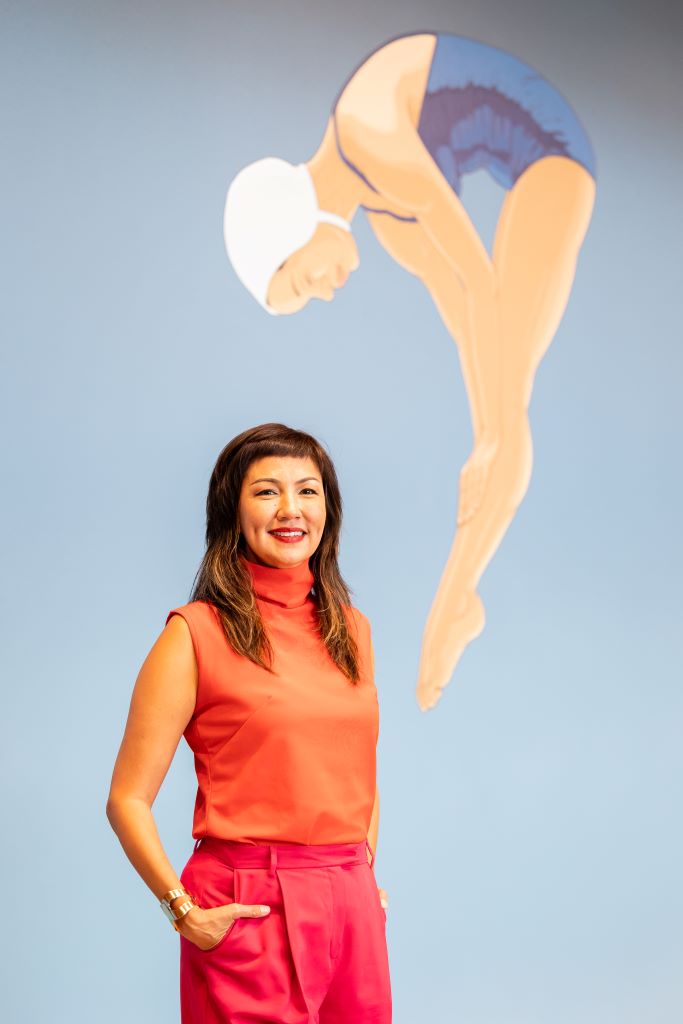
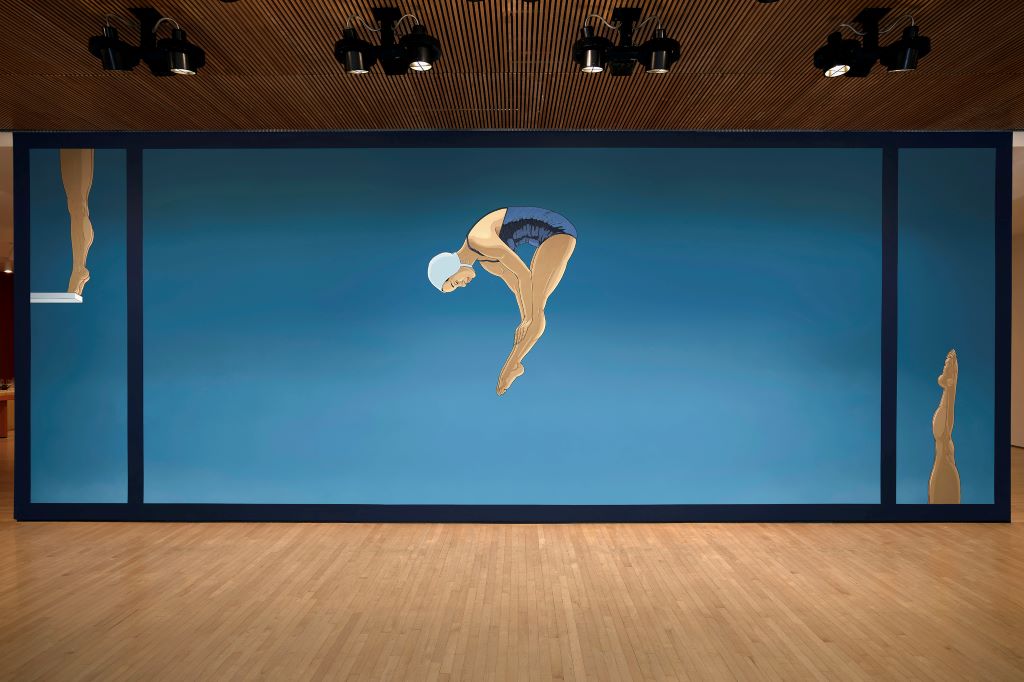
When designing her mural VMD (2024) for SFMOMA’s Bay Area Walls series, artist Jenifer K Wofford thought carefully about how to portray her subject, the legendary Filipina American diver Victoria Manalo Draves (1924–2010). Rather than her iconic swan dive, Wofford chose to depict Manalo Draves in the pike position — bent at the waist, toes pointed straight down — to emphasize her “soft inward focus . . . both completely on display and totally inside herself.”
Born in 1924 in San Francisco to a Filipino father and English mother, Manalo Draves would have been familiar with this duality. To train and compete in the segregated facilities of 1940s San Francisco, she hid her Filipina identity and initially swam as Vicki Taylor, taking her mother’s maiden surname. Manalo Draves went on to make history as the first Asian American Olympic gold medalist and first woman awarded gold for both the ten-meter platform and the three-meter springboard competitions at the London 1948 Olympic Games.
An artist and educator whose interdisciplinary work plays with notions of hybridity, history, and calamity, Wofford shares Manalo Draves’s Filipina American heritage and San Francisco roots. She received a San Francisco Arts Commission grant to create a series dedicated to Manalo Draves prior to the Bay Area Walls project, paying homage to the groundbreaking diver through paintings and works on paper. She has since created takeaway prints for distribution at public and community events in partnership with the SOMA Pilipinas Filipino Cultural Heritage District in the South of Market neighborhood where Manalo Draves grew up. Today, SOMA boasts several tributes to Manalo Draves, including a public park that bears her name.
In the mural, Wofford applied a similar palette and graphic style as her VMD prints to three freeze-frame panels on a monumental scale, the diver’s central pike suspended in a vast gradient of color. For Wofford, the mural’s prominent placement on the Floor 3 landing at the museum, which is also located in SOMA, further honors Manalo Draves. “It feels like she’s come home in a way,” Wofford said in an interview with 48 Hills magazine, “. . . like Filipino American history is finally visible.”