1902, California, United States 1984, Carmel, Central
Audio Stories
Adams shares his deep connection to Yosemite
Show TranscriptHide Transcript
transcripts
NARRATOR:
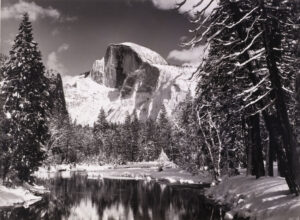
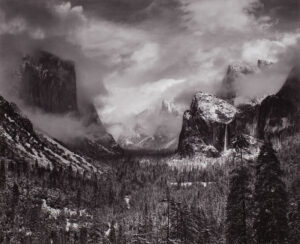
Many of America’s early-20th-century artists studied in Europe. Ansel Adams did not—and he didn’t aspire to make work like Europeans, either. Instead, the San Francisco–born Adams tried to establish a photographic style unique to the American West. He traveled the country with his collection of large-format cameras, capturing the vastness and majesty of the natural landscape.
Adams went to great lengths to make his pictures appear unmanipulated. In fact, much of his creative work took place in the darkroom, where he painstakingly perfected the tones of each individual print. It’s part of a process he called “visualization.” Adams—a classically trained pianist—liked to compare the printing process to a musical performance:
ANSEL ADAMS:
I say this very often, and I don’t know whether people realize just exactly what it meant. When you visualize a photograph, it is not only a matter of seeing it in the mind’s eye, but it’s also, and primarily, a matter of feeling it: feeling the various qualities that you wish to obtain in the final print. The shutter is operated, and then the negative is developed. The negative can now be compared to a musical score. It’s ready for its performance: the print. If the negative is properly composed, technically and aesthetically, it can be performed so as to recreate the original visualized intention. So that finally, I can say that I—I visualized the essence of the photograph to be.