
This program has tiered pricing. Please select the option that works for you:
$0 — Free RSVP
$10 — General
$20 — Extra Support
$30 — Pay It Forward
A thing brilliant and powerful, but the nastiest smear of paint I had ever seen . . .
— Leo Stein on Henri Matisse’s Femme au chapeau
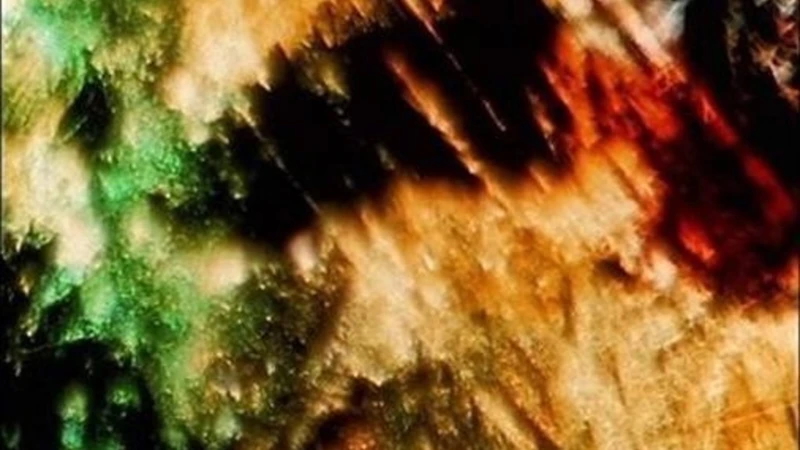
In resonance with Matisse’s Femme au chapeau: A Modern Scandal, San Francisco Cinematheque presents A Thing Brilliant and Powerful, a program of films on paint, painting, and paintings, films of exuberant gesture and explosions of color, and works that consider the ethics of representation and exhibition. Stephanie Barber’s 3 Peonies (2027) is a single-shot sacrificial still life. Cauleen Smith’s epistolary rumination Entitled (2008) also considers the politics of the still life in a sextet of missives to the Old Masters, from Vermeer to Velázquez to Charles Ethan Porter. Dad’s Stick (2012) by John Smith is an elegiac ode to accidental abstraction, while The Or Cloud (2001) by Fred Worden — an “adventure for the eyeballs” — is a rushing, black-and-white “stream of articulated energy.” The program also includes a revival digital video screening of Work (1993), Pelle Lowe’s full-frontal Super-8 send up of Olympia — the 1863 painting by Édouard Manet that scandalized Paris four decades before Femme au chapeau — starring filmmaker Saul Levine as the recumbent and wisecracking object of desire. Closing the show is Stan Brakhage & Phil Solomon’s Elementary Phrases (1994), a silently explosive abstract epic in which Brakhage’s bold paint-on-film brushstrokes are meticulously modulated by master printer Solomon.
This program is dedicated to the memory of filmmaker Fred Worden (1946–2025).
Please note: This screening includes mature content.
Entitled (2008) by Cauleen Smith (digital video, color, silent, 7 mins., exhibition file from the maker)
Speculative still lifes project desire on painters and attempt to collapse time by sharing mundane details about the contemporary conditions of life in some American cities. — The Flaherty Seminar, 2016
3 Peonies (2017) by Stephanie Barber (16mm, color, sound, 3 mins., print from Canyon Cinema)
3 Peonies is a brief, poetic 16mm film of a simple sculptural action. What becomes apparent is the humor possible in material interactions and the tender and sometimes melodramatic symbolism of cut flowers. The reverence for beauty ends up pointing towards the Abstract Expressionism and Color Field painting of high modernism that, in many cases, eschewed the banality of such “natural” beauty. The collaged soundtrack subtly contemplates mental illness and is gently insistent behind the flatness of the utilitarian sounds of ripping tape. — Stephanie Barber
Dad’s Stick (2012) by John Smith (digital video, color, sound, 5 mins., exhibition file from LUX)
Dad’s Stick features three well-used objects that were shown to the artist by his father shortly before he died. Two of these were so steeped in history that their original forms and functions were almost completely obscured. The third object seemed to be instantly recognizable, but it turned out to be something else entirely. Focusing on these ambiguous artifacts and events relating to their history, Dad’s Stick creates a dialogue between abstraction and literal meaning, exploring the contradictions of memory to hint at the character of “a perfectionist with a steady hand.” — John Smith
The Or Cloud (2001) by Fred Worden (16mm, B&W, silent, 7 mins., print from Canyon Cinema)
A guided adventure for the eyeballs. And as such, also, of necessity, an adventure of the mind (how could it be otherwise?). I believe there is a current which runs at the core of all beings, call it the life force, a dynamic which in individuals reflects both the personal and the universal. Up on the screen, frames in motion, a rushing stream of articulated energy to resonate with that inner biological current. Adventurous eyeballing then, in the ideal, an epiphanous moment of mutual recognition and commiseration between energy forms. “There is a vibration which exists to enrapture and console us.” (Rainer Maria Rilke). I like to think this vibration can be detected streaming out of The Or Cloud. — Fred Worden
Work (1994–1995) by Pelle Lowe (Super-8mm screened as digital video, color, sound, 20 mins., exhibition file from the maker)
. . . strains a familiar image by Édouard Manet — Olympia (1863) — to reveal underlying relations of gender and power between artist and model. By way of a series of displacements, signifiers float like capital through a demimonde of sex, drugs, and rock ‘n’ roll. — Pelle Lowe
Elementary Phrases (1994) by Stan Brakhage & Phil Solomon (16mm, color, silent, 33 mins., print from Canyon Cinema)
The profound nature of this concept will be better understood, and the positive study of it more successful, if we think of such an organization, in its temporal aspect and scope, as corresponding exactly to what is called in music the phrasing; distinguished both from the melody (which is based on the differences of pitch) and from the rhythm (based on the repetition of an arsis-thesis system). Like rhythm, it is based on facts of intensity (nuances) even while its form is extended over a dimension analogous to that of melody.
Whoever distinctly grasps these ideas will feel the importance of what we must call the phrasing of a picture, and for example, the stylistic importance of the differences observable between the slow, full, majestic phrasing of a Veronese (that of Tintoretto is more suave with equal plenitude), the rugged phrasing of Caravaggio (powerful in its boldness, brutal, even a bit melodramatic), the essentially polyphonic and architectonic phrasing of N. Poussin, or again the pathetic and tormented phrasing of Delacroix. It is entirely reasonable to note a likeness with these characteristics in the music of Palestrina, Monteverdi, Bach, or Berlioz. — Etienne Souriau in “Time in the Plastic Arts” from Reflections on Art, Susan K. Langer ed.
San Francisco Cinematheque cultivates the international field of noncommercial artist-made cinema. San Francisco Cinematheque inspires aesthetic dialogue among artists, stimulates critical discourse, and encourages appreciation of artist-made cinema across the broader cultural landscape. Cinematheque’s mission is accomplished through work in three primary areas: curated public programming, publications, and archives.
Accessibility accommodations such as American Sign Language (ASL) interpretation and assisted listening devices are available upon request ten business days in advance.
Please email publicengagement@sfmoma.org, and we will do our best to fulfill your request.
Presenting Sponsor of Thursday Night Live is Zoox.

Meaningful support is provided by Diana Nelson and John Atwater.
Additional support is provided by the Yerba Buena Partnership.