Pardon our dust; we're working on a new installation that affects the Atrium and Floors 3, 4, and 5.

Free with museum admission.
Please note: The presentation will not be on view from 1–5 p.m. on August 22 and 23.
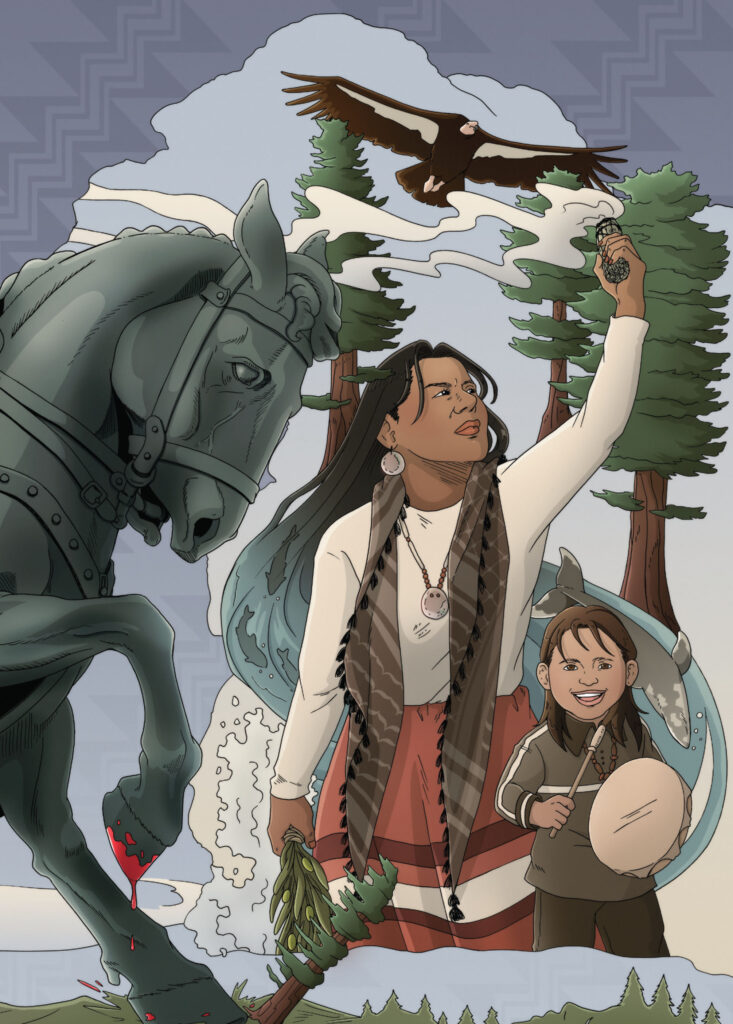
Created as part of the American Indian Cultural District’s Mapping Genocide Project, this presentation aims to highlight the history of commemorating individuals who contributed to the genocide of American Indians through place names and public art in the San Francisco Civic Art Collection.
The illustrations by artist Jackie Fawn (Yurok/Washoe/Surigaonon) prompt reflection on the untold brutality imposed on Native peoples, while celebrating the strength and resilience of survivors both historically and today. The map identifies thirty-seven street names in San Francisco, as well the location of ten statues and/or monuments in the San Francisco Civic Art Collection that have contributed to the direct violence and attempted erasure of American Indian people.
We invite viewers to reflect and share your thoughts by completing a brief survey via a QR code. Your feedback will help us understand how this presentation expands public knowledge about American Indian genocide as well as understand the impact it has had on those who experienced it.
Founded on March 31, 2020, the American Indian Cultural District (AICD) is the first established cultural district of its size in the United States dedicated to recognizing, honoring, and celebrating the American Indian legacy, culture, people, and contributions. The AICD is located on unceded Ramaytush Ohlone land in what is now known as the Mission neighborhood, in a part of the city that holds a unique concentration of historical events, cultural resources, and American Indian–based organizations, programming, services, and gathering spaces that are historically and presently important to the American Indian community in the San Francisco Bay Area.
Jackie Fawn is a Yurok, Washoe, and Surigaonon graphic illustrator from Klamath, California, currently residing in Akwesasne, Mohawk Territory. Her vivid depictions of warrior women defending the land and people against modern-day colonialism have been recognized in Indigenous spaces and beyond. Fawn’s work has circulated in traditional ecological knowledge (TEK) curricula and environmental and health campaigns to uplift Indigenous resiliency and healing. She is a self-taught artist dramatically influenced by creative resistance tactics taught by Indigenous frontline mentors.
This project was generously supported by California Humanities.