6 Questions About KAWS Answered
KAWS: FAMILY, opening November 15 at SFMOMA, is the first major solo exhibition on the West Coast for the artist KAWS. Through more than 100 works that tap into the nostalgia and familiarity of universal archetypes and commercial brands, the exhibition captures the artist’s agility at blending old and new, grit and whimsy, and emotion and wit as he breaks down the barrier between popular culture and fine art.

1. Who is KAWS?
KAWS (born Brian Donnelly, 1974) is a Brooklyn-based artist who chose the name simply because he liked how the letters looked together. He started as a graffiti artist while a teen in the mid-1990s, painting sites around his hometown of Jersey City, New Jersey, and nearby New York City. Over time, his practice evolved into painting over advertisements installed on phone booths, bus shelters, and billboards with characters of his invention. KAWS would remove the posters from their original housing, take them back to his studio, paint on them, then reinstall the transformed works back on the street. He went on to study illustration at the School of the Visual Arts while continuing his graffiti practice with ever-bolder interventions.
KAWS describes the freedom — and the learning opportunity — of those early days: “Jersey was a playground. I could paint a freight yard . . . and we wouldn’t get chased. We could just be out painting — sometimes in the day, but mostly at night. . . . [Y]ou’d paint and then come back in the light of day and be either pleasantly surprised or disappointed by the color combinations you chose.”1
Illicit graffiti may call for speed and spontaneity, but KAWS’s notebooks of sketches, which he has kept since his youth, document the meticulous planning and intentions behind his early graffiti pieces.

2. Is KAWS a commercial artist or a fine artist?
To KAWS, there is no distinction. His work bridges consumer culture and fine art, working across painting, product design, fashion, large-scale sculpture, and technology. “Though art history has tended to situate a critical divide between fine and commercial art, KAWS’s work across media and markets feels refreshingly indifferent to preconceived strata of aesthetic experience and art collecting,” notes Daryl McCurdy, curatorial associate of architecture and design and curator of KAWS: FAMILY at SFMOMA.
Art is for all in KAWS’s world. In an interview with the Art Gallery of Ontario (AGO), which originally organized KAWS: FAMILY, the artist says, “There’s no hierarchy in my head — it’s not as though painting is some elevated thing and sneakers or album designs are somehow lesser. I approach everything with the same sort of appreciation and effort.” He adds, “I try to make the surface of my sculptures look like the plastic toys I make because I want to push back against this perception that because something is plastic, somehow it’s not art; like it’s a product or something. And if something is bronze, suddenly it’s ‘elevated.’ I want to wash those distinctions away.”
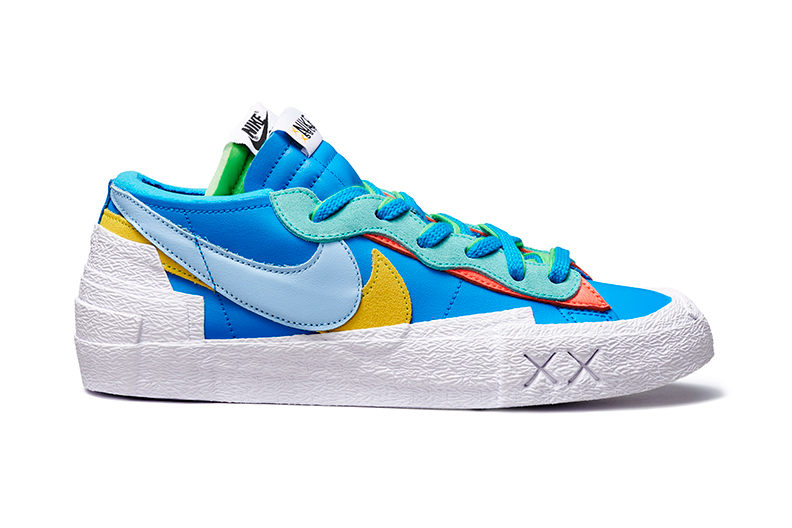
3. Who has KAWS collaborated with?
Early in his career, KAWS worked alongside graffiti artists including ZEPHYR, NACE, and WEST. “Graffiti culture is like a laboratory for the production of public art, with a social message and ‘content’ for large audiences,” says the AGO’s Julian Cox, the organizing curator of the exhibition. “It also offers community and partnership, things central to KAWS’s outlook from the beginning that have sustained him ever since, stimulating a profusion of collaborations across multiple markets and networks.”
KAWS is a prolific collaborator in the music and fashion worlds. J-Hope and Pharrell Williams are among the musicians who have commissioned KAWS to design album covers. His fashion collaborations with brands like A Bathing Ape, Supreme, The North Face, Dior, Uniqlo, and Nike are highly sought after by fans and collectors of his work. A partnership with General Mills in 2022 delivered KAWS’s take on beloved cereal mascots Franken Berry, Count Chocula, Boo-Berry, and Frute Brute on limited-edition cereal boxes. His forays into design include luxury timepieces for Audemars Piguet, a loveseat (on view in the exhibition) of sewn-together plush toys made in partnership with Estudio Campana, and basketball uniforms for the Brooklyn Nets.

4. How does KAWS use cartoon characters and commercial brands in his work?
KAWS’s recurring cast of characters is influenced by pop culture icons and mascots that he brings into his own unique visual language. In 1999, COMPANION became the artist’s first vinyl toy. Created in partnership with the Japanese brand Bounty Hunter, the limited-edition collectible caused a frenzy among collectors and catapulted KAWS into the pop culture zeitgeist. KAWS has since added CHUM, BFF, and ACCOMPLICE to his creative universe, each bearing reference to sources from iconic animation and advertisements and drawn with the artist’s signature X-ed out eyes.
KAWS has also become known for his more direct appropriations of cartoon culture from Snoopy, SpongeBob SquarePants, and the Simpsons (refashioned as the KIMPSONS). He does not appropriate cartoon characters for the sake of social commentary or dystopian fantasy, but for their role as universal visual archetypes. “Cartoons travel throughout cultures and throughout different countries in a way that humans or language don’t,” he says. “[ . . . ] Even though our languages don’t overlap, our youth references can, and I just love the mobility of that [cartoon] aesthetic.”2

5. What is the KAWS FAMILY?
The centerpiece of the exhibition is the larger-than-life bronze sculpture FAMILY (2021) that presents three of KAWS’s characters posed as a family unit. COMPANION and BFF stand tall as parent figures behind smaller childlike versions of CHUM and COMPANION (the latter clutching a doll-sized CHUM).
“These characters appear in different versions and materials in the exhibition, but all with the intent to have the viewer project something onto them, maximizing points of connectivity and recognition, not just in brand recognition, but in kinship with what this character might be thinking and feeling,” says William Hernández Luege, former curatorial associate of painting and sculpture at SFMOMA.

6. Who collects KAWS (and who does KAWS collect)?
KAWS’s work is collected by fans of all types, from movie stars, hip-hop royalty, and fine arts collectors to the kid down the street. KAWS follows in a similar tradition as Keith Haring and Andy Warhol, artists savvy to the influence of popular culture on art and vice versa. Like Haring’s Pop Shop in the 1980s, KAWS’s OriginalFake store in Tokyo, open from 2006 to 2013, was a venue he used as a creative outlet, and operated on his own terms.
KAWS is an avid collector himself. He holds a large collection of works by Chinese American painter Martin Wong, who was active in the 1970s to the 1990s and co-founded the Museum of American Graffiti in New York’s East Village in 1989. KAWS’s collection also includes works by R. Crumb, Joyce Pensato, Ed Ruscha, Peter Saul, and Tadanori Yokoo, artists whose graphics, cartoon influences, and Pop art sensibilities share a kinship with his.
KAWS sees museum presentations of his work as an important chance to connect with audiences and provide points of entry into the world of art. “There are thousands of those vinyl figures out in the world,” he says, referring to his own creations. “And the idea that a young person who’s had one on their bookshelf for the last five years can come in and see it in the museum is important to me.”3
KAWS: FAMILY is on view November 15, 2025, through May 3, 2026, on Floor 4.
KAWS: FAMILY is organized by the Art Gallery of Ontario (AGO) and curated by Julian Cox, Deputy Director & Chief Curator, AGO. The San Francisco Museum of Modern Art (SFMOMA) presentation is curated by Daryl McCurdy, Curatorial Associate, Architecture and Design, with William Hernández Luege, former Curatorial Associate, Painting and Sculpture.
Lead support for KAWS: FAMILY is provided by the Phyllis C. Wattis Fund for Traveling Exhibitions.
- M.H. Miller, “The Surprising Ascent of KAWS,” The New York Times Magazine, February 9, 2021; https://www.nytimes.com/2021/02/09/magazine/thesurprising-ascent-of-kaws.html
- Matthew Rolfe, “In conversation with KAWS,” FOYER, Art Gallery of Ontario,< October 26, 2023; https://readfoyer.com/article/conversation-kaws
- Matthew Rolfe, “In conversation with KAWS,” FOYER, Art Gallery of Ontario,< October 26, 2023; https://readfoyer.com/article/conversation-kaws