Alexander Calder
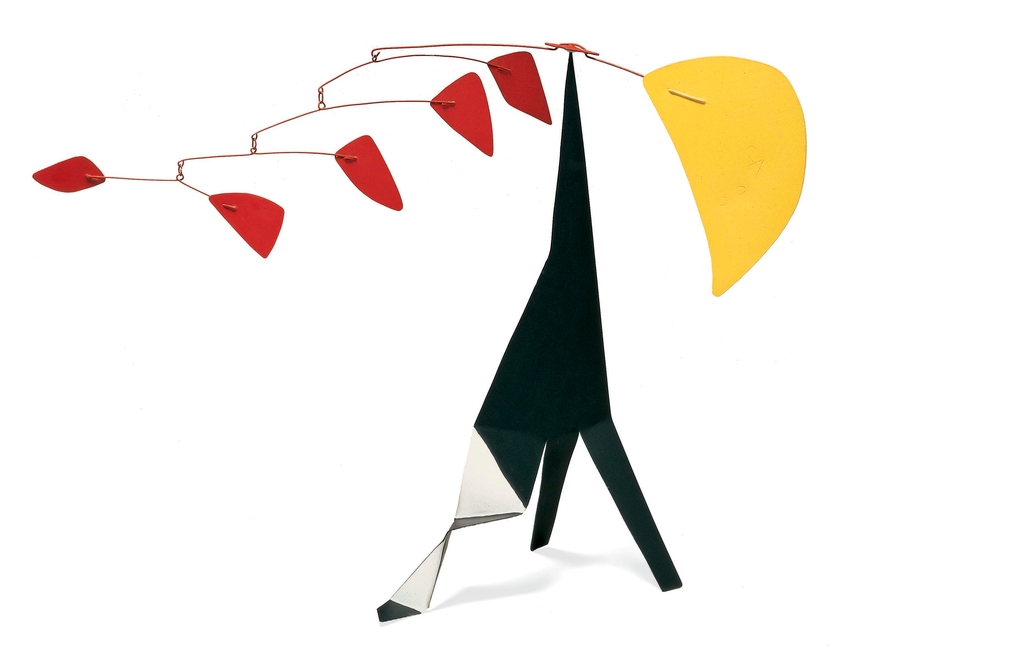
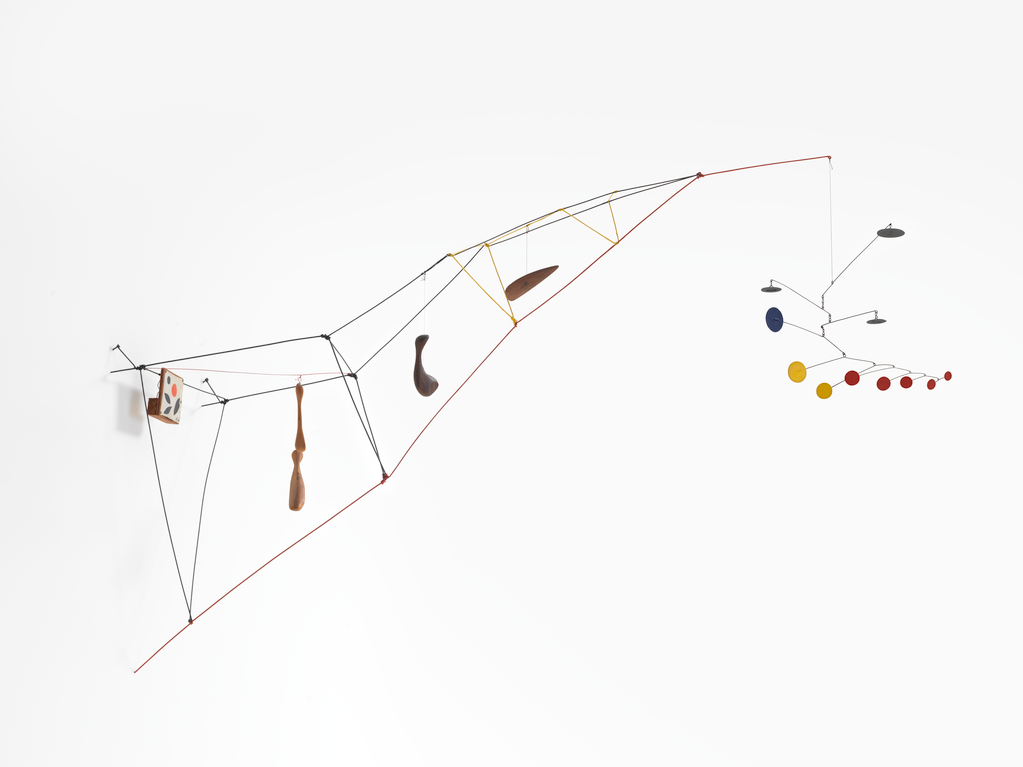
“Sculpture has become . . . an aerial act,” wrote an enthusiastic critic in 1929 about the work of Alexander Calder. Although this observation was prompted by Calder’s early, figurative wire sculptures, it could just as well describe the hanging “mobiles” the artist created in the early 1930s. In these extraordinary constructions, carefully counterbalanced elements move with passing air currents. Sculpture had traditionally meant solid, unmoving forms, but through these and other works, Calder transformed the medium into an art of lightness, space, motion, and time.
The works on view in this gallery span from the late 1920s, when Calder was a young artist in Paris, to 1976, the year of his death, and include a variety of mobiles alongside other standing and wall-mounted works that testify to his restless invention.
Calder’s work combines a lasting interest in the physical forces of the natural world with a talent for experimentation. Using mostly simple tools (shears and pliers) and modest materials (wire, sheet metal, paint, wood), Calder produced dynamic and energetic compositions of color, shape, movement, and sometimes even sound.




Visionary support for Reimagined: The Fisher Collection at 10 is provided by Fisher Art Foundation.
Lead support is provided by Penny S. and James G. Coulter, Mimi and Peter Haas Fund, and Diana Nelson and John Atwater.
Presenting support is provided by Dana and Bob Emery.
Major support is provided by Katie Hall and Tom Knutsen.
Significant support is provided by Concepción S. and Irwin Federman, Alexandria and Kevin Marchetti, and Deborah and Kenneth Novack.
Meaningful support is provided by Alka and Ravin Agrawal, Sabrina Buell and Yves Béhar, Nancy and Alan Schatzberg, and Susan Swig.
Header image: Alexander Calder: Dissonant Harmony (installation view, SFMOMA, 2021); © 2026 Calder Foundation, New York / Artists Rights Society (ARS), New York; photo: Katherine Du Tiel