
SAN FRANCISCO, CA (January 20, 2026)–The San Francisco Museum of Modern Art (SFMOMA) announces the acquisition of 85 modern and contemporary artworks—ranging from cutting-edge contemporary media art and photography to ceramics, sculpture and paintings.
SFMOMA’s acquisitions over the past six months include drawings by Ruth Asawa; paintings by Michael Armitage, Lenore Chinn, George Longfish, Jaune Quick-to-See Smith, Sylvia Sleigh and Kay WalkingStick; 30 early vintage prints by Nan Goldin, along with photographs by Eugène Atget, Pia Paulina Guilmoth, Dorothea Lange, Gabriel Orozco and Wendel White, among others.
Notable three-dimensional artworks acquired by SFMOMA include large-scale sculptures by Firelei Báez, Sheila Hicks, Tau Lewis and Yoshitomo Nara; works in clay, wood, metal and enamel by Laura Andreson, Arthur Espenet Carpenter, David Gilhooly, Harrison McIntosh, Gertrud and Otto Natzler, Merry Renk and June Schwarcz; and design objects by Robell Awake, Garry Knox Bennett, Chris Cornelius, Grete Jalk, Minjae Kim, Paulo and Nadezhda Mendes da Rocha and Leon Ransmeier.
Also added to the collection are a sound installation by Raven Chacon and video works by Gerald Clarke and Cannupa Hanska Luger, as well as four kinetic digital paintings by Samia Halaby that will be presented in the museum’s Evelyn and Walter Haas, Jr. Atrium on Floor 1 beginning January 24, 2026.
“Whether photographs or paintings, ceramics or fiber, design or digital media, these additions to SFMOMA’s collection demonstrate the relevance of art to better understanding our world and each other,” remarked Christopher Bedford, Helen and Charles Schwab Director of SFMOMA. “Our recent acquisitions highlight artists whose works are deserving of greater recognition and will further the museum’s goal of telling a broader and more inclusive story about the art of our time.”
Notably, a significant number of SFMOMA’s recent acquisitions further the museum’s ongoing efforts to foreground Native and Indigenous voices within the narrative of modern and contemporary art.
ACQUISITION HIGHLIGHTS
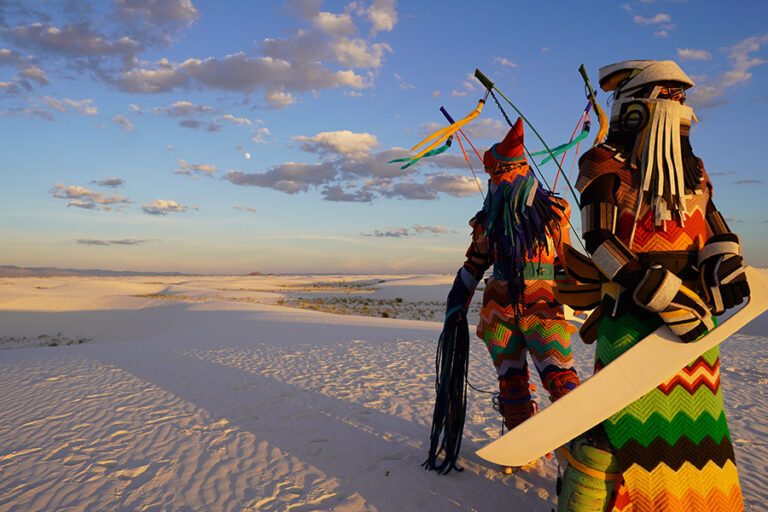
Cannupa Hanska Luger, Mirror Shield Project: River (The Water Serpent), 2016, and Future Ancestral Technologies: New Myth, 2021
Cannupa Hanska Luger is an interdisciplinary artist born on the Standing Rock Indian Reservation in North Dakota and an enrolled member of the Three Affiliated Tribes of Fort Berthold (Mandan, Hidatsa, Arikara) and Lakota. Mirror Shield Project started in 2016 when the artist learned the pathway of the Dakota Access Pipeline was proposed to be rerouted through Standing Rock. Luger put out a call for action and an online tutorial video on how to build mirror shields as protective gear. Over a thousand shields were created by the public and transported to Standing Rock. The video Mirror Shield Project: River (The Water Serpent) documents a collaborative performance engaging more than 150 Water Protectors in a site-specific action of walking the entire Oceti Sakown camp site while holding the mirror shields overhead, reflecting the surveillance of police planes. In Luger’s Future Ancestral Technologies series, speculative fiction blends with ancestral knowledge, and the video New Myth creates an allegory for the collective ability to fight against oppressive systems and repair the earth’s relationship to water.
Raven Chacon, Storm Pattern, 2021
Raven Chacon is a Pulitzer Prize–winning composer and visual artist from Fort Defiance, Arizona, Navajo Nation. In 2016, Chacon traveled to the Standing Rock Sioux Reservation to support the resistance movement organized against the construction of the Dakota Access Pipeline. Inspired by his time there, the artist created Storm Pattern, a textile score and sound installation. The title refers to a traditional Navajo style weaving featuring four zigzag lines that represent thunder or lightning and symbolize the Navajo creation story. Chacon’s looping soundscape is composed of field recordings captured at Standing Rock, including protest activities and the constant sonic presence of flying drones that overshadowed sounds from nature. The overlapping sonic layers gradually become denser, creating a symbolic form of protection and a celebration of resilience.
In addition, SFMOMA will debut the artist’s new five-channel film with drawings and an ambient soundtrack in the exhibition New Work: Raven Chacon, on view October 24, 2026–November 7, 2027.
Jaune Quick-to-See Smith, I See Red: Indian Hand, 1993
Jaune Quick-to-See Smith was an enrolled Salish member of the Confederated Salish and Kootenai Nation who was celebrated for her incisive explorations of Native identity within the context of American cultural and political structures. I See Red: Indian Hand incorporates Native symbols taken from mass media with gestural painting techniques rooted in modernist traditions. Framed by the outline of a hand, the composition is layered with comics, advertisements and headlines that alternately focus on the humanity of Native people and normalize colonial violence. Ultimately, this charged landscape invites viewers to reckon with the complexities of representation and historical memory. I See Red: Indian Hand is the first work by Smith to enter SFMOMA’s collection.
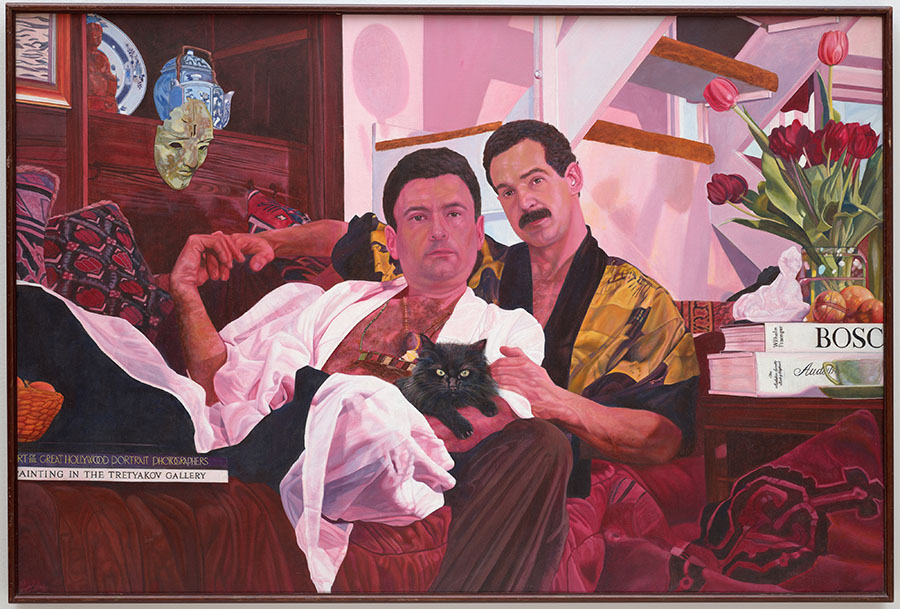
Lenore Chinn, The Family, 1991, and Bok Kai Temple, 2009
A dedicated documentarian of the Bay Area, Lenore Chinn is a painter, photographer and activist whose artistic practice has been shaped indelibly by the history of San Francisco. Chinn undertook photography in the 1970s while studying at San Francisco State University and has continued to chronicle her community in the decades since. The Family, painted during the height of the AIDS crisis, was commissioned by the artist John Arbuckle as the final portrait of him and his partner, Gary Pike, who was in the late stages of AIDS. Echoing 17th-century Dutch vanitas paintings, the symbolic flowers, fruits and books that surround them allude to life’s impermanence. Bok Kai Temple depicts lunar new year at one of the country’s oldest Chinese temples, located in Northern California. Chinn deftly paints a spread of offerings that mix the sacred and common: oranges, burning incense, Calla lilies, plastic water bottles and cooking oil. Chinn’s palette is enflamed, intensifying this scene of worship and celebration. The two paintings are the first works by Chinn to enter the collection, and The Family will be featured in 1900 to Now: SFMOMA’s Collection on Floor 2 beginning January 24, 2026.
Sylvia Sleigh, Annunciation: Paul Rosano, 1975
Sylvia Sleigh was an important feminist artist best known for detailed portraits of people she knew, including artists and critics associated with the New York art world. Sleigh’s painting Annunciation: Paul Rosano, measuring more than seven feet tall, masterfully depicts one of her most frequent models larger than life and at the peak of his physicality. Rosano is surrounded by meticulously stylized flora and appears bare-chested in a jean jacket and cutoff denim shorts. His bountiful crown of hair is illuminated from above and shaped like a halo, emphasizing his appearance as a divine messenger of 1970s counterculture. Annunciation: Paul Rosano is the first work by Sleigh to enter SFMOMA’s collection, strengthening the museum’s holdings of significant paintings by women and artists associated with the Second Wave Feminist movement.
Gabriel Orozco, At the Cotton Factory (En la fabrica de algodon), 1993; Juego de Limones, 2001; Mi Oficina II, 1992; and Sandwich Steps, 2000
Gabriel Orozco is best known as a sculptor, though his practice also spans painting, drawing, photography and video. Between 1992 and 2001, Orozco produced a wide array of photographs during his travels, taking his practice out of the studio and onto the street. Using the camera, he staged and documented subtle “interventions,” creating understated and humorous visual arrangements that function like a photographic readymade. For Orozco, photography is a way of engaging directly with the world and recording that experience. His photographs reflect an attentiveness to the unexpected details of daily life. These four vintage prints complement nine works by Orozco previously acquired by SFMOMA, expanding the museum’s collection of his photographs.
Wendel White, Manual Training and Industrial School for Colored Youth, Bordentown, New Jersey, 2008; and Marshalltown School, Mannington, New Jersey, 2008
Wendel White draws attention to the African American experience through archival research, oral histories and experimental photographs. After White moved to southern New Jersey in 1986, he began to learn about majority-Black towns in the state. His research broadened into a 13-year project that involved documenting residents and buildings to honor the waning existence of Black communities. The two photographs recently acquired by SFMOMA are part of his series Schools for the Colored, in which White focused on all-Black schools to consider how prevalent segregated and unequal education was for Black children in states like New Jersey. Inspired by a quote in W.E.B Du Bois’ book The Souls of Black Folks, which describes life as a Black person in relation to whiteness as though one were separated by a veil, White photographed historic Black schools or their former sites, using digital processing to alter the images. The photographs read as architectural studies with a thick but translucent white veil over the landscape.
Robell Awake, Safari, 2025
Robell Awake, a chairmaker based in Atlanta, Georgia, is known for his craft and use of Pan-African symbols and patterns, blending his Ethiopian heritage and American upbringing. Safari is a variation of the 17th-century Ladderback chair, and the title refers to ecotourism in Africa focused on wildlife conservation without consideration for the extraction of natural resources used in consumer products. To highlight the unsafe labor conditions of cobalt mining in the Democratic Republic of Congo, Awake included a USB-C cable in the seat of Safari that appears to drip blood. The chairback features a vibrantly painted lion’s face with yellow eyes and sparking teeth, reminiscent of American face vessels and Ethiopian talismanic scrolls that were used as spiritual protection for healing and resilience.
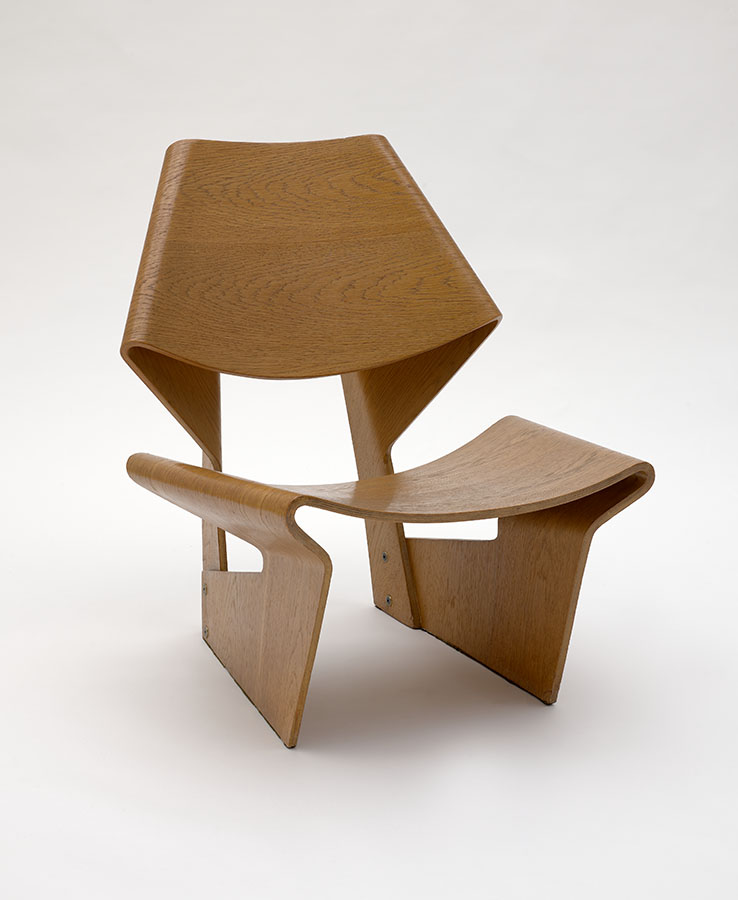
Grete Jalk, GJ Chair (Bow Chair), 1963
One of the most important figures of Danish Modern furniture, Grete Jalk established herself as a vocal and esteemed proponent of nuanced and refined craft in her approachable wood and metal works. The GJ Chair, also known as the Bow Chair, is Jalk’s most celebrated chair and one of Danish Modernism’s most important and iconic works of design. With this work, Jalk pushed the limit of bent plywood fabrication, creating form with a tight internal bending radius that was difficult to produce. This complexity is balanced by the poetic simplicity of the chair itself: two similar bent plywood shapes attached with an overlapping joint and four screws. The forms evoke origami, folding back on themselves for structural rigidity, while the rounded bends of the chair’s back and seat are inviting and comfortable. This work exemplifies SFMOMA’s interest in innovation and imagination in modern and contemporary design.
Sheila Hicks, Rempart (Rampart), 2016 and Kerala, 2002
For nearly seven decades, Sheila Hicks has redefined the expressive possibilities of fiber as a sculptural medium. She incorporates natural and synthetic materials at a range of scales, from intimate weavings to monumental installations. Rempart (Rampart) (2016) is a significant sculpture comprising a tumbling pile of bales of vibrant red pigmented acrylic fiber encased in nets. Hicks transforms a material typically used to make Sunbrella patio furniture into a human-scale mound that pushes up against the wall. Kerala (2002) is from a significant body of small works made on a hand-held loom. Here, flower stems and clam shells are incorporated into a gridded cotton and wool composition that point to the artist’s daily discoveries. The two recent acquisitions are standouts from SFMOMA’s current exhibition, New Work: Sheila Hicks.
San Francisco Museum of Modern Art
151 Third Street
San Francisco, CA 94103
The San Francisco Museum of Modern Art is one of the largest museums of modern and contemporary art in the United States and a thriving cultural center for the Bay Area. Our remarkable collection of painting, sculpture, photography, architecture, design and media arts is housed in a LEED Gold-certified building designed by the global architects Snøhetta and Mario Botta. In addition to our seven gallery floors, SFMOMA now offers over 45,000 square feet of free, art-filled public space open to all.
Visit sfmoma.org or call 415.357.4000 for more information.
Follow us on X for updates and announcements: @SFMOMA_Press
Images:
Cannupa Hanska Luger, Future Ancestral Technologies: New Myth, 2021; image: courtesy the artist and Garth Greenan Gallery, New York; © Cannupa Hanska Luger; photo: Gabriel Fermin
Lenore Chinn, The Family, 1991; San Francisco Museum of Modern Art, Accessions Committee Fund purchase, by exchange, through the T.B. Walker Foundation Fund; © Lenore Chinn; photo: Don Ross
Grete Jalk, GJ Chair (Bow Chair), 1963; San Francisco Museum of Modern Art, Purchase, by exchange, through a gift of Peggy Guggenheim; © Grete Jalk; photo: Don Ross