

SAN FRANCISCO, CA (July 14, 2026)—The San Francisco Museum of Modern Art (SFMOMA) announces the acquisition of more than 90 modern and contemporary artworks, highlighting an incredible range of formal and conceptual innovations. The group continues SFMOMA’s commitment to platforming and enriching its holdings with global and local voices, adding both depth and new breadth to the museum’s growing collection.
SFMOMA’s acquisitions over the past six months—from January to June 2026—include video installations and works by Stephanie Comilang and Simon Speiser, Alexandra Daisy Ginsberg, Ana Mendieta and Agnieszka Polska; works on paper by Arakawa + Gins and Orlando Smith; sculpture and mixed media works by Dan Friedman, Betye Saar, Nobuo Sekine, Kishio Suga, Finnegan Shannon, Rose B. Simpson and Elaine Cameron-Weir; basketry by Jeremy Frey; jewelry by Merry Renk; and architecture and design objects by Jasko Begovic, Frida Escobedo, Bijoy Jain, Kwango Lee, Kim Minjae and Julian Watts, as well as collaborative work by the designers Ignacio G. Galán, David Gissen and Architensions (Alessandro Orsini and Nick Roseboro).
The museum substantively added to its extensive photography holdings with works by Alejandro Cartagena, Rahim Fortune, Lynn Hershman Leeson, Tania Franco Klein, Justine Kurland, Danny Lyon, Hiroshi Nomura, Joseph Rodriguez, Malick Sidibé and Toshiya Watanabe. SFMOMA also continued its active support for artists from the Bay Area and Northern California with acquisitions across media by artists Bernice Bing, Joan Brown, Jim Goldberg, David Huffman and Adaline Kent.
In addition to these acquisitions, SFMOMA approved more than 250 gifts of art to the museum. This included EDEN.GARDEN 1.0 (2001) by Entropy8Zuper! (Auriea Harvey and Michaël Samyn), jointly acquired by SFMOMA and ZKM | Center for Art and Media, Karlsruhe, as well as 37 works by Heath Ceramics, 16 pieces of jewelry made by Jay Defeo and the Art Bookshelf Speaker by Devon Turnbull. Also among the recent gifts to the museum are paintings and works on paper by Jennifer Bartlett, Jean-Michel Basquiat, Richard Diebenkorn, Nicole Eisenman, Peter Hujar, Ellsworth Kelly, Maria Lassnig, An-My Lê, Charles Moore, Yasumasa Morimura, Yoshitomo Nara, Martin Puryear and Kunié Sugiura, among numerous others.
“Our newest acquisitions feature celebrated and lesser-represented artists; visionaries with ties to our immediate community and those from across the country and the globe; and individuals with broad-ranging experience, vision and perspective. This demonstrates our institutional commitment to collecting strategically and deeply to illuminate the fullest spectrum of narratives and artistic breakthroughs,” said Christopher Bedford, Helen and Charles Schwab Director of SFMOMA. “I look forward to sharing these exceptional works in our galleries as we continue to tell stories of art and human experience that hold strong resonance for our audiences.”
ACQUISITION HIGHLIGHTS:
Bernice Bing, Velasquez Family No. II (1961)
Bernice Bing was deeply embedded in San Francisco’s artistic and cultural communities. Her paintings were inspired by a wide range of sources, including Bay Area Figurative painting, Zen Buddhism and Abstract Expressionism. Velasquez Family No. II (1961) is among Bing’s most significant early works, painted when the artist was 25 for her first solo exhibition. It is from a series of paintings that reinterpreted the art historically important painting Las Meninas (1656) by Diego Velázquez. Here, the figures of the original work are recast as abstract forms and expressive brushstrokes, revealing the artist’s engagement with color and light and her innate ability to synthesize a vast array of references into a singular visual language. Underrecognized in her lifetime, Bing’s work has recently received renewed attention. Velasquez Family No. II is the first work by the artist to enter SFMOMA’s collection and will go on view in the museum’s Floor 2 galleries July 18.
Betye Saar, House of Fortune (1988)
Since the 1960s, Betye Saar has built an iconic body of work that reflects on African American identity, spirituality and the interconnectedness of cultures. House of Fortune (1988) is among her most significant installations that foregrounds Saar’s long engagement with mysticism and ritual. Conjuring the scene of a seance, House of Fortune centers around a 1930s art deco card table and chairs. Saar traced her hands on the tabletop to create a ring of connected handprints and along the edges are Nordic runes and Haitian symbols. Surrounding the tableau are Thoth tarot cards and organic materials sourced from the location where it is shown. House of Fortune joins Saar’s The Time Inbetween (1974) in SFMOMA’s collection and substantially deepens the museum’s representation of one of the most iconic living artists.
Jim Goldberg, Destiny’s Shiny Bracelet (1989, printed 1990s) and 23 additional works from the series Raised by Wolves
Jim Goldberg’s pioneering 1995 exhibition, Raised by Wolves, was shown at SFMOMA in 1997 and has inspired generations of artists. The project, which Goldberg has called a “completely true work of fiction,” depicts young people living on the streets of San Francisco and Los Angeles. It was made over the course of ten years and follows a large cohort of intersecting subjects as they navigate the margins, using drugs, engaging in prostitution, falling in and out of love, having babies and suffering abuse, violence and neglect. These 24 photographs are the first from Goldberg’s seminal series to be acquired by the museum. Included among the photographs is a large-scale vintage gelatin silver print of Destiny’s Shiny Bracelet, a heartbreaking picture of a radiant young woman with a faraway stare. The addition of these works by Goldberg, one of the most highly respected and influential artists in California, is consistent with the museum’s goals to collect the work of important local artists.
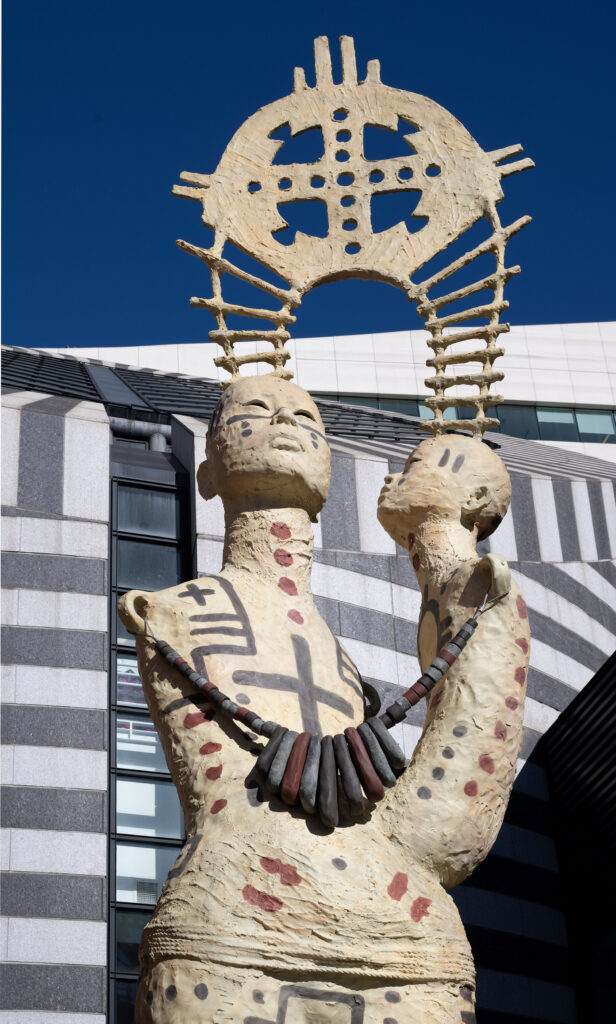
Rose B. Simpson, Behold (2025) and Behold (maquette) (2025)
Rose B. Simpson is among the leading Indigenous sculptors of her generation. Her practice—spanning ceramics, sculpture, performance and installation—draws on extensive intergenerational knowledge of Pueblo pottery traditions and explores identity, resilience and ancestral knowledge. Behold (2025) was commissioned for SFMOMA and is currently on view on the museum’s Floor 4 terrace. At nearly 25 feet tall, the monumental bronze figure represents a significant expansion of Simpson’s ceramic practice in both scale and material, translating the intimate language of her materials into monumental public form. The sculpture depicts two interconnected figures—a parent and child linked by beaded necklaces and an ornamental ladder—and looks out over Yerba Buena Gardens. The museum is also acquiring the ceramic maquette that served as its conceptual and formal foundation, preserving the hand-built sensibility central to Simpson’s practice. Together, the two works trace the full arc from studio process to public monument and are landmark additions to SFMOMA’s collection.
Alejandro Cartagena, Mother #33 and Daughter #34, from the series Without Walls (2017, printed 2026)
Born in Santo Domingo, Dominican Republic, and based in Monterrey, Mexico, Alejandro Cartagena has spent more than two decades examining the social, economic and environmental conditions shaping life in northeastern Mexico. Mother #33 and Daughter #34 are from the series Without Walls (2017), the final chapter of his trilogy about the border. Made at Friendship Park between San Diego and Tijuana, the photographs portray a mother, who is located in Mexico, and her daughter, who is in the United States. The two have met at the site each month for 10 years, with the photographs capturing their positions on opposite sides of the metal barrier. Mother #33 enters the collection through purchase and Daughter #34 has been gifted to the museum by three generous donors. The acquisitions follow the artist’s recent mid-career retrospective at SFMOMA, Ground Rules, which offered a comprehensive view of his wide-ranging, dynamic practice. These works add a fourth body of Cartagena’s work to SFMOMA’s collection, bringing the museum’s holdings to 25 photographs by the artist.
Arakawa + Gins, Gaze Brace (Study for The Process in Question/Reversible Destiny) (1978), Drawing for Container of Perceiving (1984), Reverse Symmetry Transverse Envelope Hall (1987), and three additional works
Through a decades-long collaboration, Shusaku Arakawa and Madeline Gins sought to challenge human mortality by proposing an alternative. They developed a multifaceted practice that included painting, drawing, poetry, philosophy, installations, architecture and landscape. Their architectural projects, both real and conceptual, tested their philosophy of “reversible destiny,” which held that constant activation of the mind and body could reverse aging and achieve longevity. The acquired works include a model and drawings across a body of work from the late 70s to early 90s, including Gaze Brace (1978), a study for a bridge designed to compress the viewer’s visual field, as well as two large-scale drawings for the Container of Perceiving (1983–84), a proposal for an installation in the Venetian Lagoon. Works by Arakawa + Gins will be on view on SFMOMA’s Floor 3 in Spring 2027.
Stephanie Comilang and Simon Speiser, Piña, Why is the Sky Blue? (2021) and Data Maxima (2022)
Filipina Canadian artist Stephanie Comilang explores the collective memories of migratory and diasporic experiences. Her science fiction documentaries often blend real and speculative narratives to deepen our understanding of labor, capital and cultural, social and economic mobility. Simon Speiser is a German Ecuadorian artist known for his interdisciplinary approach, which weaves together elements of nature, ancestral folklore and non-Western conceptions of technology to explore the interplay between human and technological worlds. The single-channel video and virtual reality installation Piña, Why is the Sky Blue? (2021) is a collaboration uniting the landscapes and peoples of the artists’ homelands. Set in a distant future, viewers follow the journey of Piña, a spiritual medium and artificial intelligence agent whose consciousness is formed by ancestral knowledge, and their survival relies on the preservation of our collective messages and dreams. The work is the first with a virtual reality component to enter SFMOMA’s collection. It is accompanied by the acquisition of Data Maxima (2022), a textile collage made of woven pineapple-cloth swatches with 3D-printed patterns of data visualizations melding with traditional Ecuadorian and Filipino weaving designs. In the video, the textile becomes a carrier of information, connecting various temporalities and the physical and virtual worlds.
Orlando Smith, Re-Traumatized (2022), Rehabilitation Over Punishment? (2025) and Aging Is A Fact! (2025)
Orlando Smith is a graphic artist whose drawings carry urgent political demands. A self-described “artivist”—both artist and activist—he uses pencil and paper to chronicle the senselessness of the criminal legal system and to indict abuses of power in the United States and around the globe. Driven by an irrepressible creative force—and a deep belief in the humanity of all people—Smith’s work fearlessly confronts injustice while crying out for universal civil rights. Three works recently acquired by SFMOMA illustrate Smith’s development over the past several years. Re-Traumatized (2022) documents his experience of the COVID-19 pandemic from inside the prison. Rehabilitation Over Punishment? (2025) reflects on nearly thirty years of incarceration and incorporates data on recidivism rates among San Quentin’s aging population. Aging is a Fact! (2025), a rare work by Smith in watercolor, unfolds across a scroll that echoes the visual authority of the Declaration of Independence. The three works will be included in Smith’s upcoming solo exhibition at SFMOMA, O. Smith: Artivist, opening on July 25 and featuring 30 works on paper.
Nobuo Sekine, Phase No. 9 (1968/2013) and Phase of Nothingness—Pole (1976/2013)
Kishio Suga, Scenerization (1975), Diagonal Body (1990), Edges of Perpendicular Space (1990) and Distant Circulation (1990)
Artists Nobuo Sekine and Kishio Suga, alongside artist Lee Ufan, are among the most widely recognized practitioners of Mono-ha, an influential avant-garde movement that emerged in postwar Japan. With the goal of revealing “the world as it is,” they arranged raw and industrial materials into sculptures that highlighted the relationship between objects, environment and perception.
Using optical sleights of hand, Sekine’s Phase No. 9 (1968) continually shifts between two and three dimensions to explore concepts of ambiguity and an artwork’s capacity to embody multiple states at once. Sekine’s sculpture Phase of Nothingness—Pole (1976/2013), which appears to be assembled from several parts, was carved from a single tree using an ancient Buddhist woodcutting technique. He sought to create a work that balances discrete elements and a unified whole, using this tension to explore the idea of betweenness. Scenerization (1975) is an iconic example of Suga’s practice, wherein he arranges materials into seemingly casual arrangements such that the works achieve an ephemeral state of equilibrium. The acquisitions also include three small assemblages by Suga from 1990, which represented new experiments in geometry and topology for the artist.
These acquisitions join four significant works by Lee Ufan that entered SFMOMA’s collection in 2023. Sekine’s Phase of Nothingness—Pole and Suga’s Scenerization are on view on Floor 2 of the museum, as part of the ongoing presentation 1900 to Now: SFMOMA’s Collection.
San Francisco Museum of Modern Art
151 Third Street
San Francisco, CA 94103
The San Francisco Museum of Modern Art is one of the largest museums of modern and contemporary art in the United States and a thriving cultural center for the Bay Area. Our remarkable collection of painting, sculpture, photography, architecture, design and media arts is housed in a LEED Gold-certified building designed by the global architects Snøhetta and Mario Botta. In addition to our seven gallery floors, SFMOMA now offers over 45,000 square feet of free, art-filled public space open to all.
Visit sfmoma.org or call 415.357.4000 for more information.
Follow us on X for updates and announcements: @SFMOMA_Press
Images:
Orlando Smith, Aging Is A Fact!, 2025; San Francisco Museum of Modern Art, Ruth Nash Fund purchase; © Orlando Smith; photo: Tenari Tuātagaloa
Rose B. Simpson, Behold, 2025 (installation view); San Francisco Museum of Modern Art, purchase, by exchange, through a gift of Michael D. Abrams; commissioned by SFMOMA; © Rose B. Simpson; photo: Don Ross