Pardon our dust; we're working on a new installation that affects the Atrium and Floors 3, 4, and 5.

SAN FRANCISCO, CA (June 24, 2025)–The San Francisco Museum of Modern Art (SFMOMA) announces it has acquired a robust range of new artworks over the past six months, encompassing innovative photo-based and video artworks; important works on paper, paintings and sculpture; cutting-edge design and architecture; as well as contemporary artworks that draw on craft traditions.
SFMOMA’s recent acquisitions include paintings and works on paper by Paul Chan, Kenturah Davis, Soleé Darrell, Jean LaMarr, Frank LaPena, Linda Lomahaftewa, Richard Mayhew, Peter Sacks, Kandis Williams and Takako Yamaguchi; sculpture and mixed-media works by Emanoel Araujo, Candice Lin, Daniel Lind-Ramos, Charlotte Posenenske and Kim Yun Shin; and architecture and design by Shigeru Ban, Martine Bedine, Michael Cooper and Liam Young, among many others. This group also includes photography by Catherine Opie, Trevor Paglen, Lorna Simpson, Carla Williams and Mo Yi; video, film and media artworks by Oscar Muñoz, Samson Young and others, as well as a work by Steve McQueen, jointly acquired with the Dallas Museum of Art.
The significance of ceramics, glass and textile practices in modern and contemporary art can be seen in works by Melissa Cody, Trude Guermonprez, Lee ShinJa, Marvin Lipofsky, Toshiko Takaezu, Tâm Văn Trần and many others recently acquired by SFMOMA.
SFMOMA has expanded the representation of San Francisco, Bay Area and Northern California artists in its collection by adding works by artists such as Jim Campbell, Rose D’Amato, Harry Fonseca, Angela Hennessy, Mooshka (Kevin Cata), Chelsea Ryoko Wong, William Scott, Bonnie Ora Sherk, Chloe Sherman, Rupy C. Tut and Al Wong, whose film Twin Peaks in on view on Floor 1. Additional recent acquisitions that can be viewed at the museum in 2025 include work by Kunié Sugiura in her exhibition Photopainting, continuing through September 14, and photographs by Alejandro Cartagena in his retrospective Ground Rules, opening at SFMOMA November 22.
“Our curators have deeply researched artworks and under-recognized artists from around the world and Northern California to identify works of art that are meaningful for our audiences and can speak to new ways of telling the history of art,” remarked Christopher Bedford, SFMOMA’s Helen and Charles Schwab Director. “These significant acquisitions are important examples of SFMOMA’s support for the art of our time and demonstrate the vital role of art and artists in contemporary life.”
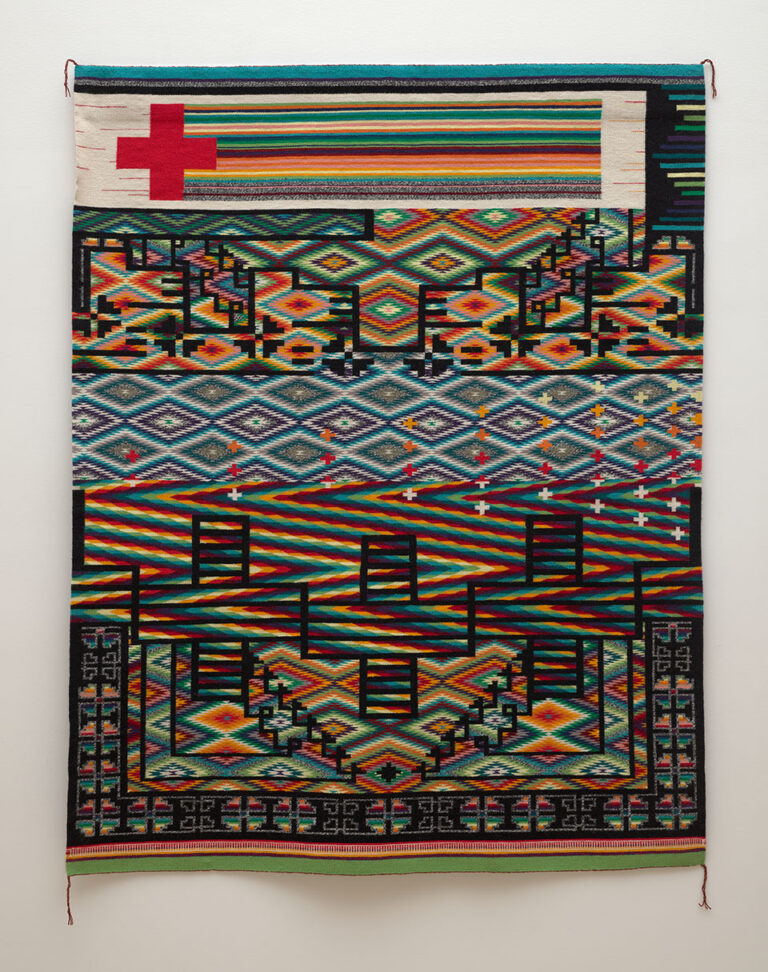
Melissa Cody, Dopamine Regression (2010). Melissa Cody approaches weaving as an ever-evolving craft and art form, and her textiles reclaim traditional Navajo/Diné imagery and techniques to address contemporary life. Cody recombines Navajo/Diné patterns into sophisticated geometric overlays and color schemes that bridge visual languages from 1980s video games to Germantown Revival weaving. Dopamine Regression, one of Cody’s most significant early weavings, reflects on her father’s battle with Parkinson’s disease. At the top, a large red cross—associated with both the medical field and the figure of Spider Woman who taught the art of weaving in Navajo/Diné cosmovision—beams rainbow rays over stacked, patterned fields. Traditional serrated diamond forms contrast with zigzags resembling brain wave scans. Cody is a fourth-generation weaver and an enrolled member of the Navajo Nation, and Dopamine Regression is the first work by Cody to enter SFMOMA’s collection.
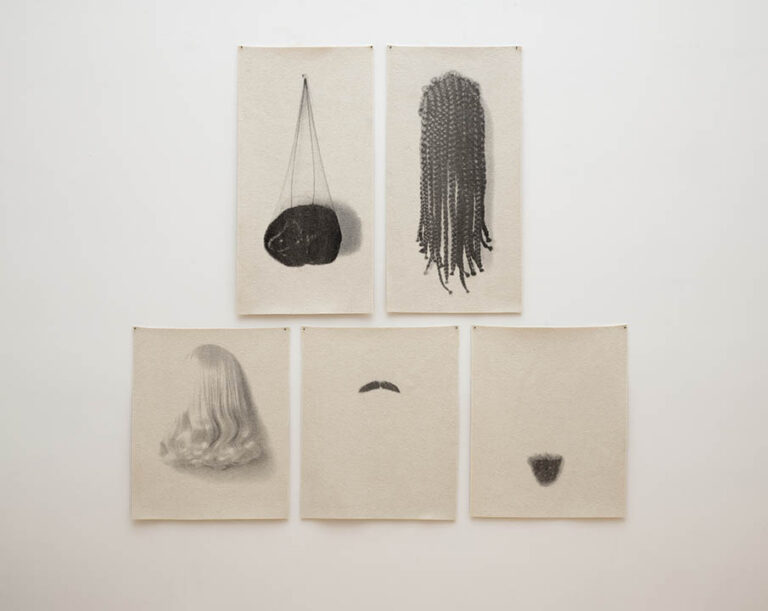
Lorna Simpson, Wigs (New Museum Configuration) (1994). For more than 30 years, Lorna Simpson has used images of hair to explore themes of gendered and racialized sight, power and negation. Wigs is comprised of a series of five waterless lithographs on felt, the texture of which references the look of hair. While Simpson’s choice to photograph the wigs from behind suggests a continuation of her earlier compositional devices, this series marks a transitional phase in the early 1990s in which the artist began to substitute the body with symbolic stand-ins. The acquisition of Wigs expands the museum’s holdings of Simpson’s early work, and is indicative of SFMOMA’s efforts to broaden the collection to better represent artists innovating across mediums and disciplines
Kim Yun Shin, Add Two Add One, Divide Two Divide One 1995-532 (1995). Kim Yun Shin is a pioneering Korean artist who is best known for wood carvings that harmonize nature and humanity, tradition and modernity, and matter and spirit. Kim’s process begins by observing the physical and energetic rhythms of her material, attending to its natural qualities before taking her chainsaw to chip and carve away. The sculpture acquired by SFMOMA was carved out of wood from the carob trees of Argentina, where Kim lived for four decades. Kim recounts that the land there felt perfectly parallel to the sky—a relationship that inspired her interest in creating sculptures that stretched for the sky, dreaming of a unification between heaven and earth, as well as humanity and nature.
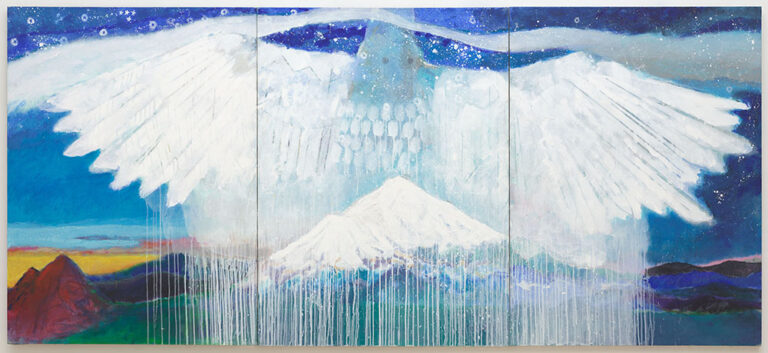
Frank LaPena, North Mountain (ca. 1989). LaPena was a hugely influential California artist, teacher, dancer, singer and leader acknowledged for his contributions to the visibility of Native arts. The artist served as the director of Native American Studies at California State University, Sacramento, for over three decades and was a cofounder of the Maidu Dancers and Traditionalists, a group dedicated to preserving and sharing traditional dances and practices. LaPena’s paintings highlight ancestral knowledge, legends and symbols, as well as sacred sites. One of his most iconic works, the triptych North Mountain, depicts a snow-capped Mount Shasta under the outstretched wings of a bird and a starry sky. His mother’s family lived for generations in the Mount Shasta area, a site of personal and spiritual significance for the artist.
Jean LaMarr, Green Shawl (early 1970s), One Numa Guy (1974) and Urban Indian Girls (1982). Jean LaMarr is an artist of Northern Paiute and Pit River ancestry whose vibrant paintings and prints depict Native histories that counter cultural stereotypes and legacies of settler colonialism. LaMarr moved to San Jose in 1964 and studied painting at UC Berkeley where her research in the University’s ethnographic collections led her to create etchings that contest myths of the “vanished American Indian.” As LaMarr has explained, “I try to show that we are still here, that we’ve survived, and that we have something to communicate.” Driven by “the idea . . . that art was for the community,” works such as Urban Indian Girls, One Numa Guy and Green Shawl evoke personal and shared experiences. LaMarr was active in the Bay Area’s Red Power and Chicanx movements, and these three additions to the museum’s collection highlight interconnected histories of Bay Area art and activism.
Trevor Paglen, A Man Grid (Corpus: The Humans) (2024) and additional works. Paglen is a long-time investigator of artificial intelligence and its entanglement with surveillance, militarism and state power. SFMOMA recently acquired six of his photographs that explore the limits, assumptions and ethical dimensions of visual perception in the era of machine vision. As part of this series, Adversarially Evolved Hallucinations, Paglen employs generative adversarial networks to produce images that appear strange, distorted and pixelated. The process involves one AI system trained on text-based image recognition and another that generates imagery to fit the taxonomies recognized by the first. These works serve as a timestamp from an early moment in AI image-generation, when outputs lacked the seamless realism of today’s models. This aesthetic—ghostly, uncanny and almost grotesque—exposes AI’s initial struggle to represent reality, inviting viewers to consider the gap between machine vision and human understanding.
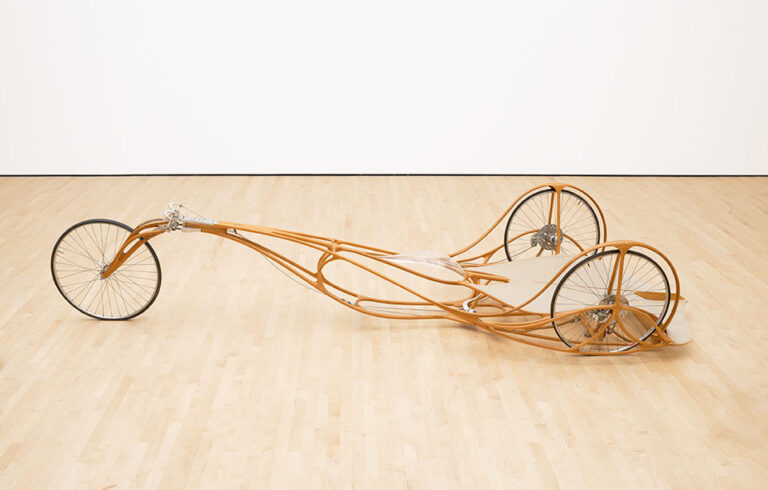
Michael Cooper, Soapbox Derby Car (1975). California artist Michael Cooper’s eccentric, one-of-a-kind sculptural vehicles fuse craft, engineering, design and hotrod culture. Cooper designed and built this laminated wood and fabric three-wheeler, titled Soapbox Racer, for SFMOMA’s First Artists’ Soapbox Derby on May 18, 1975. For this community event, the museum commissioned artists to create cars for a race in San Francisco’s McLaren Park. In 2022, the museum brought back this event and staged its first soapbox derby in 40 years to great public acclaim, with a new crop of artist-designed cars.
Shigeru Ban, Paper Log House (1995). SFMOMA is the first museum to acquire a Paper Log House by the Pritzker Prize–winning architect Shigeru Ban. In 1995, Ban responded to the need for temporary housing after the Kobe earthquake. Using easily found local materials for the foundation and roof and an innovative use of paper tubes for load-bearing walls, Ban designed the first Paper Log House. For 30 years, Shigeru Ban Architects have iterated versions of the Paper Log architecture for shelter, which have been deployed quickly in places of natural and humanitarian disaster.
Lee ShinJa, Image of City (1961). Lee ShinJa is recognized as one of the first fiber artists and educators in Korea, and Image of City is a critical early work that exemplifies her pioneering approach towards textiles. Emerging at a time when working with thread and fabric was relegated to the domestic realm, Lee forged a path for Korean textile artists, venturing into traditional and experimental techniques including weaving, winding, pulling and intertwining threads. In her early work, she would use yarn salvaged from secondhand sweaters and bedding, reflecting the scarcity of materials in postwar Korea. In Image of City, Lee deconstructs a commercially manufactured cotton tablecloth, unraveling and rewrapping threads with new fibers and yarns. The resulting tapestry exemplifies Lee’s experimentation with space, texture and form, highlighting her lifelong goal to push both the material constraints of her mediums and their social reception. This is the first work by Lee ShinJa in SFMOMA’s collection.
Marvin Lipofsky, 17 works (1964–2002). As an artist, teacher and administrator, Marvin Lipofsky was fundamental to establishing the Bay Area as a dynamic center for the studio glass movement. This suite of acquisitions will enable SFMOMA to represent the full career of a critical figure in the realms of glass, craft and postwar sculpture. His sculptures from the 1960s and 1970s reveal his material experimentations with unusual elements, such as brass filings, drain covers and flotation foam. In the 1980s, his works blossomed into the iconic forms for which he is best known today: exuberantly colored, voluptuous works that are at once painterly and sculptural.
Al Wong, Twin Peaks (1977). The first work by San Francisco artist Al Wong to enter SFMOMA’s collection is his seldom-seen masterwork Twin Peaks, which was filmed over the course of a year. Taking the idea of the journey as its form, Wong’s camera is set inside the car as he slowly drives the hypnotic figure-eight road that winds around Twin Peaks in San Francisco at different times of the day. In one part of the 50-minute film, the image splits in half and becomes out of sync, referencing Wong’s interests in the illusory nature of reality. Wong here creates an avant-garde film that symbolizes the endless cycles discussed in Zen Buddhist philosophy. Recently restored in 16mm by the Pacific Film Archive and transferred to video, the work is being presented for the first time on a digital LED screen on SFMOMA’s Floor 1 through Summer 2026. Wong is an alumnus of the San Francisco Art Institute (SFAI), where he was a longtime faculty member. SFMOMA’s presentation of Twin Peaks also will complement the exhibition People Make This Place: SFAI Stories, opening July 26, 2025.
William Scott, Praise Frisco: Peace and Love in the City (2024). Commissioned in conjunction with SFMOMA’s exhibition Creative Growth: The House That Art Built, this monumental composition celebrates “Praise Frisco,” William Scott’s name for the future San Francisco he envisions. His largest painting to date merges two of his abiding interests: detailed renderings of the cityscape and portraits of people in his life and dreams. Scott has worked with Creative Growth since 1992. This major acquisition builds on SFMOMA’s partnership with the Oakland-based progressive art studio; it also deepens the museum’s holdings by Scott, making SFMOMA the most significant institutional repository of his work.
San Francisco Museum of Modern Art
151 Third Street
San Francisco, CA 94103
The San Francisco Museum of Modern Art is one of the largest museums of modern and contemporary art in the United States and a thriving cultural center for the Bay Area. Our remarkable collection of painting, sculpture, photography, architecture, design and media arts is housed in a LEED Gold-certified building designed by the global architects Snøhetta and Mario Botta. In addition to our seven gallery floors, SFMOMA now offers over 45,000 square feet of free, art-filled public space open to all.
Visit sfmoma.org or call 415.357.4000 for more information.
Follow us on X for updates and announcements: @SFMOMA_Press
Image credits:
Frank LaPena, North Mountain, ca. 1989; San Francisco Museum of Modern Art, Deaccessions Fund purchase; © Frank LaPena; photo: Don Ross
Melissa Cody, Dopamine Regression, 2010; San Francisco Museum of Modern Art, purchase, by exchange, through a gift of Michael D. Abrams; © Melissa Cody; photo: Don Ross
Lorna Simpson, Wigs (New Museum Configuration), 1994; San Francisco Museum of Modern Art, purchase, by exchange, through a gift of Peggy Guggenheim; © Lorna Simpson; photo: Don Ross
Michael Cooper, Soapbox Derby Car, 1975; San Francisco Museum of Modern Art, Deaccessions Fund purchase; © Michael Cooper; photo: Don Ross