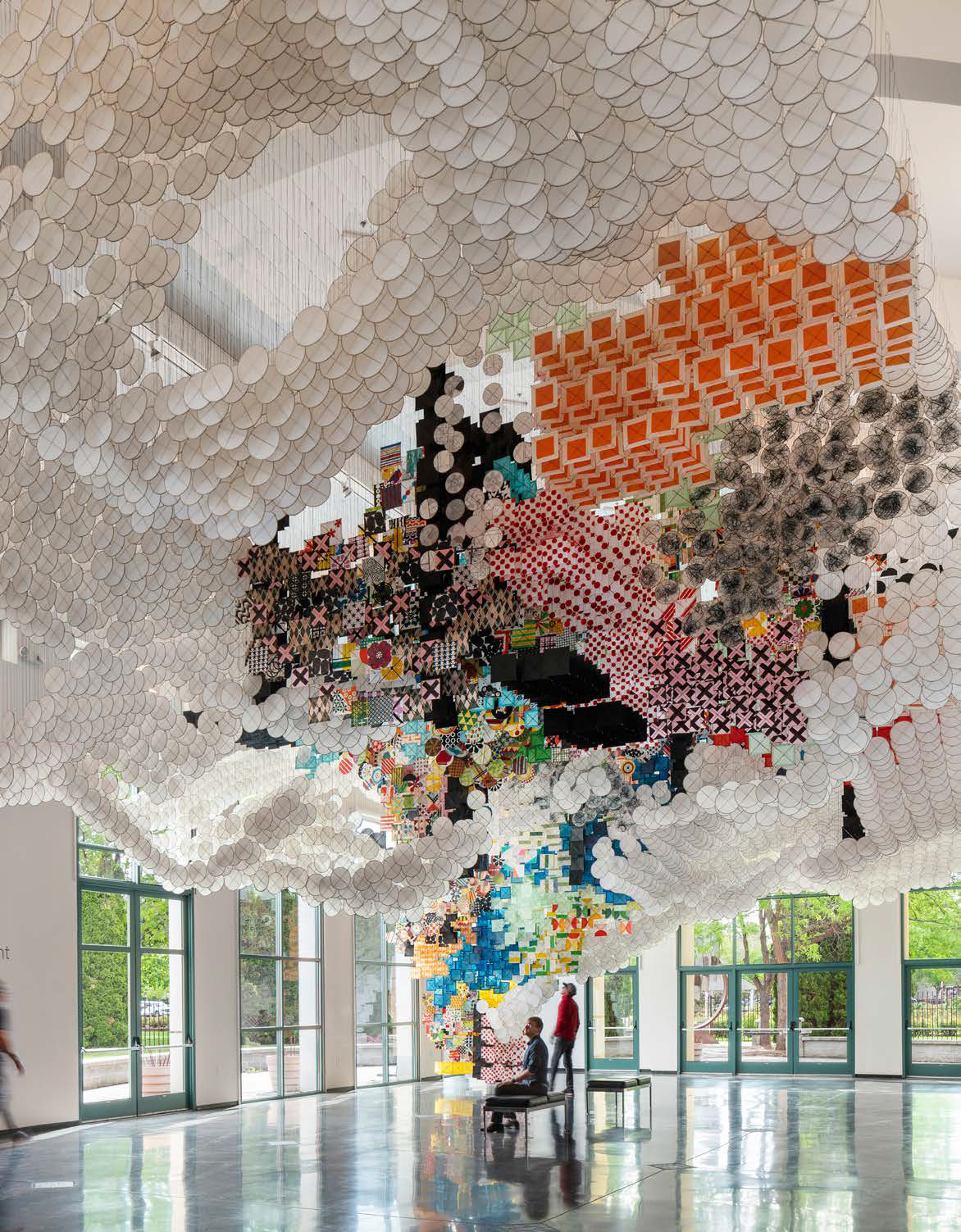
Jacob Hashimoto’s ethereal installations suggest floating landscapes and natural phenomena. In this interview with Architecture and Design Curator Joseph Becker, Hashimoto reveals the origin of kites in his work, the ways he engages with science, and his years-long quest to find the perfect paper. View Giant Arc, his latest and largest installation, in the Roberts Family Gallery on Floor 1.
Joseph Becker: How does the SFMOMA commission Giant Arc expand on your previous installations?
Jacob Hashimoto: Giant Arc adds to the language of the installation that I started thirty years ago. All of my pieces are in a way integrated into this artwork but I’m adding more that’s San Francisco specific. This is the biggest iteration I’ve ever done. Depending on how it goes, it might be the biggest iteration I ever do because it’s quite a challenge.
JB: What is the significance of the title?
JH: My big artworks started getting cosmic titles a decade ago. For SFMOMA’s space, I was envisioning an artwork in the shape of an arcing canopy or wave. I wanted something from astronomy with that same energy, and scientists had just discovered something they call the Giant Arc. There’s indication that instead of the universe being homogenous and evenly distributed, there are clumpings of cosmic objects that appear in higher density than others. It became an interesting jumping off point. We started thinking about how the metaphor might work, sculpturally and environmentally—how the places that these artworks can take you is limitless, surprising, and counterintuitive.
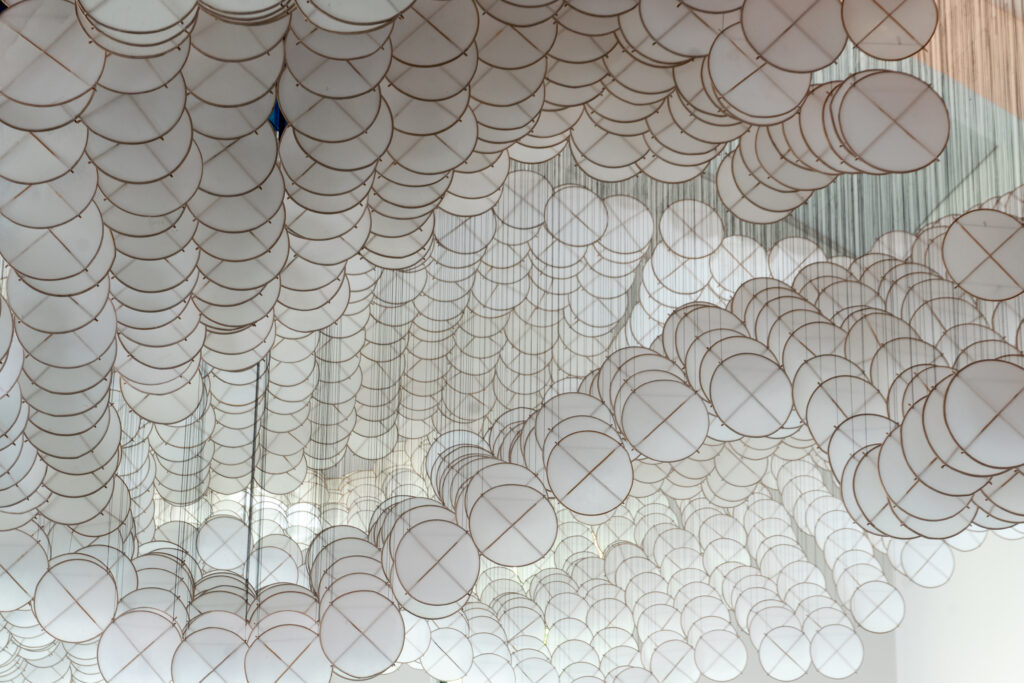
“I want you to feel like you’re sitting on a beach right before a storm watching the waves crashing, and you’re just hanging out . . . It’s like creation myths that we share – that energy of sitting at the edge of the abyss that is very difficult to achieve through the language of sculpture.”
JB: What do you hope visitors take away from the experience of Giant Arc?
JH: I hope people are intrigued purely by the amount of hand labor and craft in the work. They should also be able to lose themselves in it. Some will look at how it is built and its meaning. Others might approach it from their physical experience, like the dancer’s logic of how the piece moves through space and its relationship to the landscape. I hope people come away with a transformative experience — an affirmation or learning about themselves. Even if it’s just respite, that’s success.
Museum and gallery exhibitions are often a relentless barrage. Some works are, like, deal with this. This artwork doesn’t ask people to deal with it. There’s poetry, beauty, magic, and possibility built in that is almost childlike. We all come to this originally with an open-mindedness as kids, right? This piece is joyful, complex, full of chaos, and such a mixed bag of things that children experience every second of their lives. It sets the stage for curiosity. It’s a fitting entrance into the museum experience.
JB: Wonder is often stimulated by nature, things like clouds, wind, light, or oceans. How does nature inspire your pieces?
JH: I want you to feel like you’re sitting on a beach right before a storm watching the waves crashing, and you’re just hanging out. There’s a sense of calm and terror and beauty. It’s like creation myths that we share – that energy of sitting at the edge of the abyss that is very difficult to achieve through the language of sculpture. If I can get one-tenth of that energy into the museum, it’s successful.
Artists like Olafur Eliasson can bridge that gap between these incredible transformative experiences of nature and the language of artwork. A handful of artists can pull that off, but it’s tougher than people think.
JB: What is the significance of kites in your work?
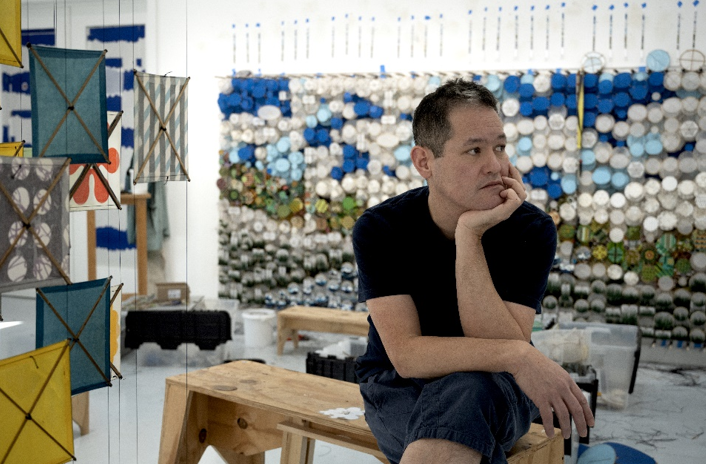
JH: The kites came about in the 1990s when I was a painting student at the School of the Art Institute of Chicago. I was making big abstract landscapes, but it was hard to find my own language working in abstraction. I got frustrated and was unable to paint for months. I talked to my dad, who has taught writing at Whitman College for many years. In graduate school, he and his friends would run journal-writing exercises with students to try to see what is physiological about the act of writing, how much creativity is generated from the body. Students would write stream of consciousness in their journals and when they ended a thought, they would write the same word over and over until another thought emerged. He said it was surprisingly successful in pushing people past boundaries that they couldn’t cross before. He said, “Maybe do something in the studio that’s not painting to take the pressure off. Just make whatever you want — model airplanes or build kites.” I thought, kites.
When I was a kid, my dad built little diamond-shaped kites — two little spars of bamboo glued to origami paper. He had been taught to build kites by his father, who used cut-up chopsticks. It drove my grandmother crazy because it was like taking all the forks in the house. My dad learned from his dad, but my father never taught me to build kites.
I decided to teach myself to build kites as a meditation on the things my dad didn’t teach me. I had just seen Andrei Tarkovsky’s Andrei Rublev, which is one of my favorite movies. It’s about a man who is trying to make a bell. He’s the son of a bell maker who has died. All the villages bring him metal for a bell, but his father never taught him how to make one, so he’s stressing out about pouring the bell. It’s the idea that at some point in our lives, we must take responsibility for learning or teaching ourselves.
I started building kites but also had to finish paintings for my final critique in art school. I had forty kites thumbtacked to the wall. To free up wall space, I hung a wire across my studio and paperclipped the kites in the middle. One day I looked up at these kites and thought, “I could totally do something with this.” If I used them sculpturally to build landscapes or environments, I could do everything I was trying to do with painting.
JB: How have your techniques for constructing kites evolved?
JH: Originally it was important that I build every piece and tie every knot. At some point my father started helping, coming during spring breaks to tie knots. I was building hexagonal, octagonal, and rectangular Japanese kites, but wanted to make a circle kite. I researched how to heat-treat bamboo to bend it and realized I was out of my depth. In 2000, I found a Chinese government website that led me to kite makers in Weifang in Shandong province, birthplace of the round dragon kites in Chinatowns all over. One company had done work for Coca-Cola and McDonald’s, so I reached out to them. The son didn’t want to do it, but the dad was interested. I worked with him to make 5,000 round kites, which we showed in Verona, Italy.
JB: Has the paper you use changed?
JH: Initially, the round dragon kites used stretched silk, which is not made to last. Over the years, they got very brittle and cracked. Hiromi from Hiromi Paper in Los Angeles worked with me to figure out paper options. She introduced me to thicker, machine-made rayon papers from Japan that have become the foundation for my kites for the last twenty years. Machine-made rayon paper has a neutral pH and doesn’t change color much.
My collage papers came through a different process. There were beautiful papers from Hiromi that were transparent, super diaphanous, and incredibly beautiful, but the colors were unstable. Works would go out for shows and come back completely changed in color.
She introduced me to this fellow, Hiroya, who had inherited his family’s paper mill in Tokyo. I explained the problems and showed him the DIY UV-testing machine we’d built to vet our papers. I knew I couldn’t eliminate change, but I wanted to understand it so I could craft the artworks so they changed in a consistent fashion.
Hiroya sent us paper samples to test. Our UV box irradiated them twenty-four hours a day for six months. We rated the papers weekly to see how they changed over time. The first dozen he sent failed miserably. He disappeared for a year, then he sent this paper sample in three colors. We put them in our cooker and they were amazing. Over three months of testing, they shifted only slightly. To this day, he makes almost all the color papers we use because they’re the most light-fast, color-stable papers we’ve found.
Giant Arc is like a wild animal — some of its papers are from 2000 and look like brown grass while others are new and super crisp green. There’s also wrapping paper from 1998 in there. Since the work is my property, I’m ok with the changes in pieces. It brings an energy and recklessness that is part of the history. But if it were going into a museum collection, it would become a problem for conservation because it’s not archival.
JB: How do you arrive at the patterns you use?
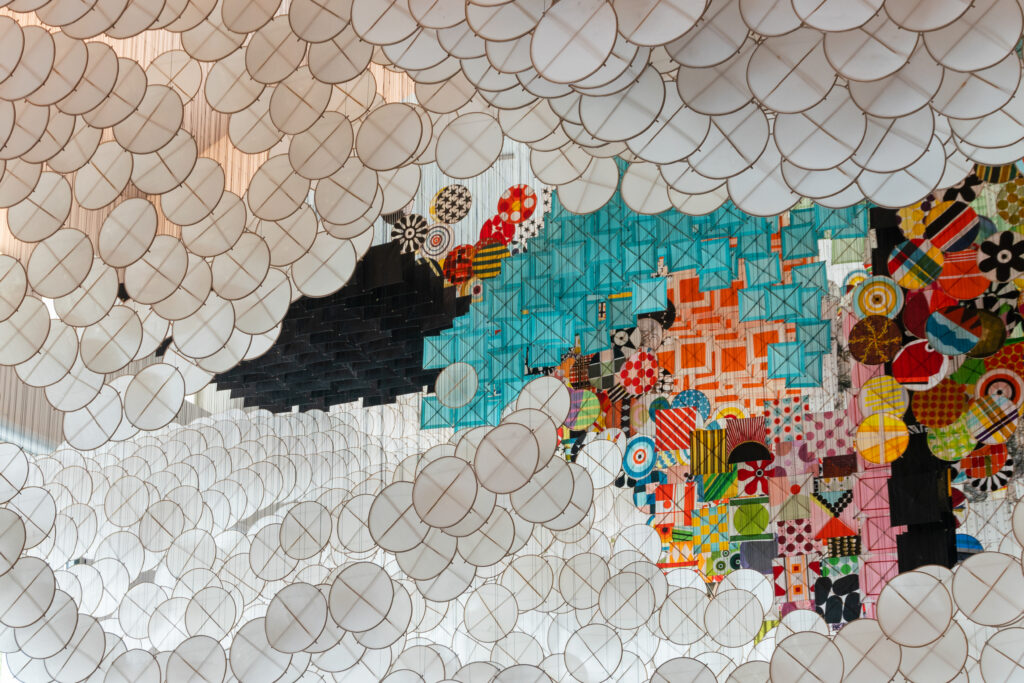
JH: I create the key pattern or overarching theme, which comes from a variety of places. During COVID, I was interested in plagues and communicable diseases like typhus and H1N1. We took their cellular schematics and built patterns from them. We also researched details from religious or civic architecture constructed during plague times. In Venice, we used a cutout of a Venetian window as a pattern. Many of these were meditations on the horror and beauty of plagues.
Individual patterns often come from my studio assistants and what they’re interested in. One year, an assistant was into Frank Lloyd Wright and Prairie School architecture. Everything looked like stained-glass windows. Another assistant once made argyle patterns based on her socks. We use these patterns to create neighborhoods of language within the artworks.
For Giant Arc, I wanted patterns specific to this region. When you think about San Francisco, you think of the Transamerica building or Golden Gate Bridge, but there are also richer places to go with it. I looked at endemic species, like flowers that used to populate the region but are now only found in Santa Cruz, and Dahlias, the city flower.
JB: How do you move works from your studio to on-site?
JH: There are roughly 70,000 pieces in Giant Arc, so it’s pure engineering and planning. It’s finding fabricators, doing design work, figuring out how we mount things to the ceiling. We spent two months going through thirty years of kites, opening boxes that haven’t been looked at for decades, repairing things, and repackaging them.
From there, colored and patterned pieces were sorted into like types. For smaller installations, I often take the boxes to the site, line them up, and start building. Giant Arc is so big and spans so much history that I was more intentional about how I wanted different eras of installation positioned in the final piece. Things are mixed in, juxtaposed, and come from different times. We built a landscape.
For the white canopies and black section that I call the eclipse, the order was more linear. I needed to know how many white and silk pieces I had from which generation. White pieces from different generations used different adhesives and changed colors differently. Once that was established, we organized the pieces via 3D modeling to see how they would change as you moved across the arc. Each module within that is printed on a sheet that shows the height and pattern of each piece used there. Those pieces are assembled horizontally on a table then flat packed and brought to the site. 3D modeling gets us eighty-five percent there, but there are always things you don’t understand until you’re on-site.
The big dropping section in the front of the gallery we organized by neighborhood: this pattern here and that pattern there. We tested those chunks at full scale in Frank Stella’s New York studio, which has 27-foot-high ceilings. I installed a grid to the ceiling and hung pieces in place by hand using a scissor lift and scaffolding, doing fifteen-by-thirty-feet blocks at a time. We measured and documented each section with pictures, so we knew where to transition to the next chunk, then we packed it up and started the next grouping. The oldest kites I wanted hung as they were originally in the ‘90s, which was a kite with a loop of string and another kite beneath it. They can’t be flat packed together beforehand, so we installed them individually on-site.
A special thing about these works is watching them grow. Taking them down is also a dramatic, beautiful process.
Jacob Hashimoto: Giant Arc is on view August 22, 2026 through June 2028.