The museum will be closed September 14–16, 2026 for a private event. The Museum Store will remain open to the public from 3rd Street.

For Sol LeWitt (1928–2007), walls weren’t just for hanging art but sites for exploring concepts. Breaking with traditional composition and the subjectivity of Abstract Expressionism in the early 1960s, LeWitt began creating minimalist works influenced by geometry and serial progression. By 1967, he had shifted his focus to carrying out a series of predetermined instructions or plans as encapsulated by his famous dictum, “The idea becomes the machine that makes the art.” This notion helped define Conceptual art as it emerged in the late 1960s. It was also the guiding principle behind LeWitt’s wall drawings, the body of work for which he is best known.
LeWitt created his first wall drawing in 1968 by hand, but almost immediately began delegating their execution to hired artists. These individuals became his collaborators in art making, though he maintained in the 1971 article “Doing Wall Drawings” that “the wall drawing is the artist’s art, as long as the plan is not violated.”
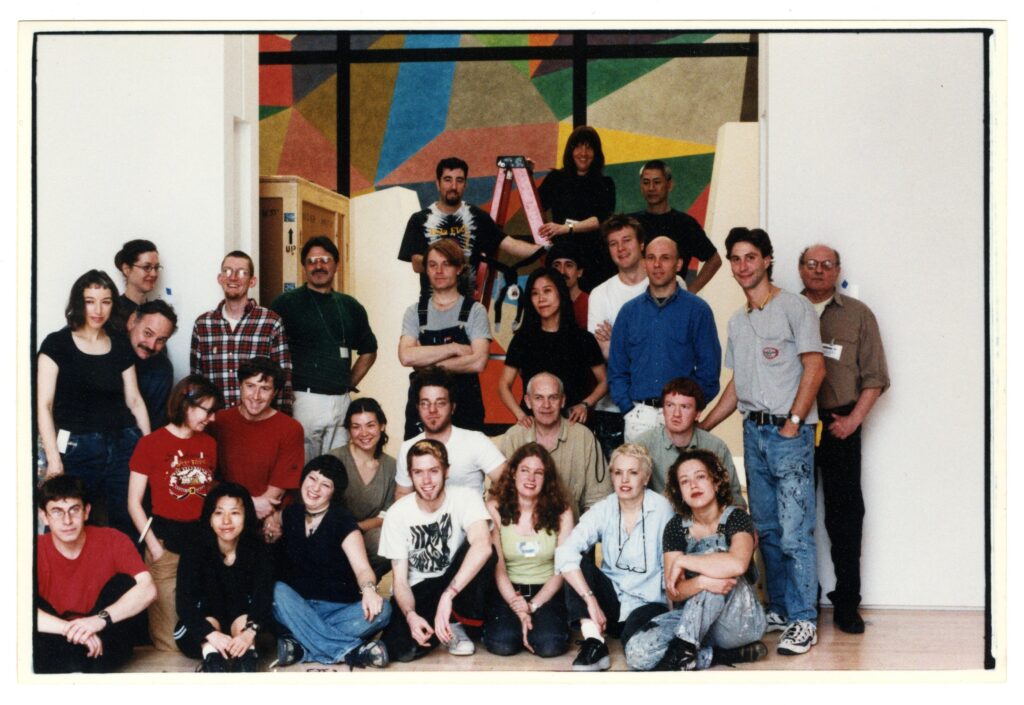
When a museum or collector purchases a LeWitt wall drawing, they receive a certificate of authenticity and a diagram that provides a schematic visual representation of the work. Early wall drawings had instructions within their titles, such as Wall Drawing #73: Lines, not straight, not touching, drawn at random, uniformly dispersed with maximum density, covering the entire surface of the wall (1971). Since his directions leave room for interpretation — and misinterpretation — LeWitt instituted a system where trained drafters from his studio supervise the local artists hired to execute the murals in situ. “It’s a system that has allowed for the skills to be passed down and perpetuated in order to keep the work alive,” says Ted Mann, project assistant curator for the Fisher Collection.
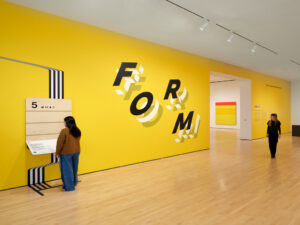
This spring, twenty-one works by the artist will be included in Calder, Kelly, LeWitt: Fundamentals of Form, a new ongoing presentation that is part of Reimagined: The Fisher Collection at 10. This mini survey will contain six wall drawings along with drawings, artist books, and modular “structures,” LeWitt’s term for sculptures.
Wall drawings can be adapted to different architectural settings and scaled up or down, so long as they remain true to LeWitt’s original plans. Teams also follow meticulous production techniques codified over decades — whether it’s the Caran d’Ache crayon used or how curves are outlined in masking tape in preparation for painting. “Everything follows this very methodical production line. They even know how long it takes a particular kind of ink to dry,” says Collections Manager Nancy Arms Simon, who worked on wall drawings for the 2000 SFMOMA exhibition Sol LeWitt: A Retrospective before joining the museum full time.
Read more about Arms Simon’s experience in this interview.
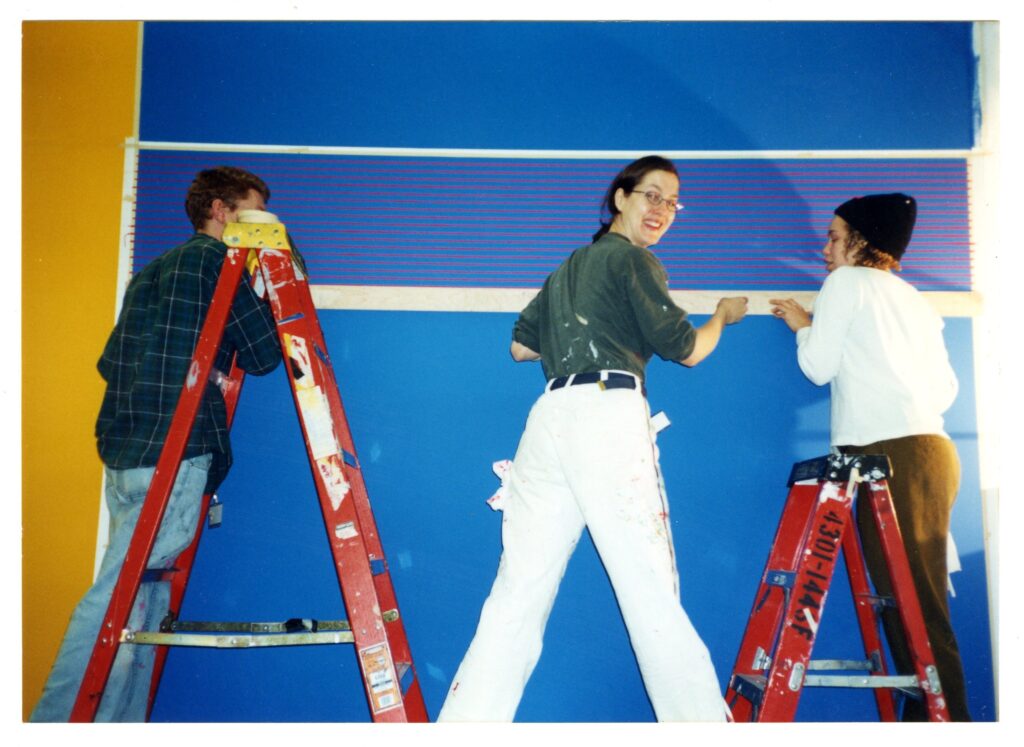
These painstaking processes yield consistency. “One installation I was involved with used a specific lead thickness and straight edge to cover a wall with eight- or nine-inch lines,” says Brandon Larson, gallery infrastructure and fabrication manager, who oversees SFMOMA installations. “I was struck by how specific they were about the pressure used to draw each line. It was spectacular because the difference in fidelity from one person’s work to another was invisible.”
Using teams to execute wall drawings, however, still leaves some decision-making to the artists and drafters. For the 2000 installation of Lines, not straight, not touching […], Arms Simon says, “If you use the analogy that LeWitt has written a piece of music and the orchestra is playing it, I was interpreting that music maybe a little too much in my own way.” Despite her concerns, supervising assistants signed off and LeWitt himself stopped by and said, “That looks nice.”
Visitors will be able to experience Wall Drawing #273 (September 1975), last shown at SFMOMA in 2016, in-gallery as well as from a window seat in the adjacent studio space. “This work occupies seven gallery walls and features straight lines in blue, red, and yellow that begin at the corners and midpoints of the walls,” says Mann. “It is up to the drafters to determine how many lines to draw and where on the underlying pencil grid each line ends. So the work changes with each installation, not only based on the size and layout of the walls, but also on the drafters’ decisions.”
The six installations in the presentation span LeWitt’s entire wall drawing practice, from Wall Drawing #1 (1968), his first, to Wall Drawing #1237 (2007), from his last group of works. A highlight is Wall Drawing #477 (1986), created during his time living in Spoleto, Italy, and presented at SFMOMA for the first time. It marks the artist’s transition to using subtle washes of ink or acrylic, which many credit to the early Renaissance frescoes he encountered in Italy.
Larson is eager to see how LeWitt’s wall drawings turn out this time around. “As long as certain conditions exist and you follow the instructions from the start point to the next point, the piece will arrive where it needs to be,” he says. “You can build a whole world with this very straightforward logic he wrote out.”
Calder, Kelly, LeWitt: Fundamentals of Form is part of Reimagined: The Fisher Collection at 10, on view
beginning April 18, 2026, on Floor 5. Learn more at sfmoma.org/fisher-collection.