Before joining SFMOMA as a staff member in 2015, Nancy Arms Simon had a life-changing art experience working with Sol LeWitt and his team installing wall drawings for the museum’s 2000 exhibition, Sol LeWitt: A Retrospective. LeWitt’s wall drawings are made anew for every show by crews of artists and follow very specific directions that also have ambiguity baked in, which can be both helpful and not helpful. Here she talks through the process.
Which Sol LeWitt wall drawings did you work on?
NANCY ARMS SIMON: I worked on wall drawings for the 2000 LeWitt retrospective at SFMOMA. I worked on Lines, not straight, not touching, drawn at random, uniformly dispersed with maximum density, covering the entire surface of the wall. and two other wall drawings.
How did you find out about the opportunity?
NAS: I am entirely indebted to Arnold Kemp, who worked at SFMOMA at the time. I met him when he was a curator at Yerba Buena Center for the Arts (YBCA). He really wanted to see people of color on the crew, and he recommended me to the LeWitt studio. I was doing on-call preparator work at the time, primarily at YBCA because it was my favorite place, but I also worked at the Legion of Honor, the Mexican Museum, a lot of different places. For this project, I worked as part of LeWitt’s crew, so I was vetted through them.
How was work assigned?
NAS: There were some people, Amy Rathbone was one, Spy Emerson was another, whose art practice fit in with their assignment. I was recommended as a drawer/painter, so I think that’s why I was assigned a pencil wall drawing, specifically a one-color 8H pencil drawing.
How many people worked on the wall drawings that you did?
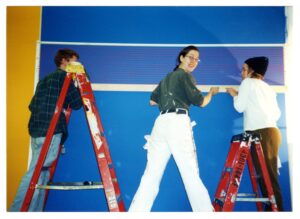
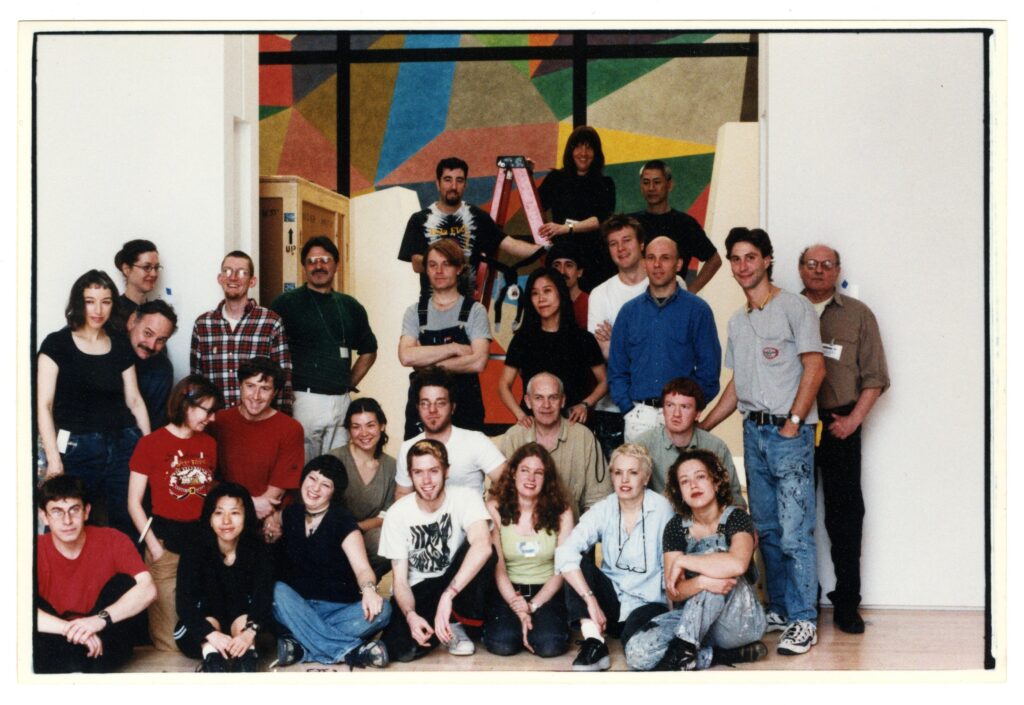
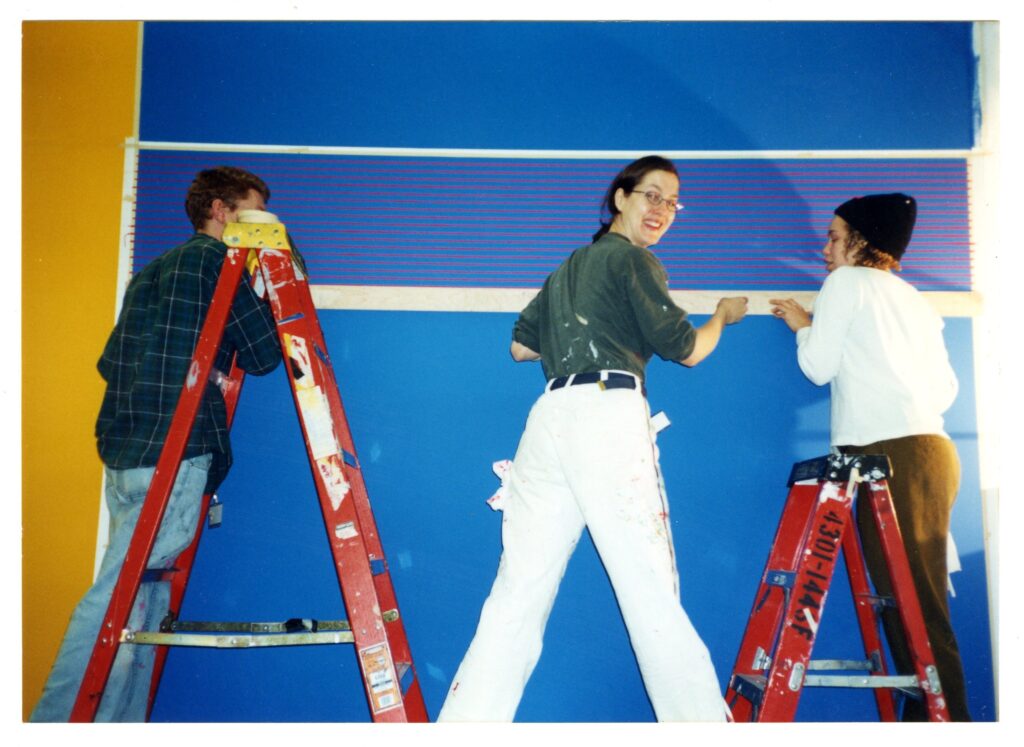
NAS: With Lines, Not Straight, Not Touching [. . .] it was just me, and then they moved me to different teams. One wall drawing took three of us because it was created using this long straight edge. Two people had to hold the straight edge while one of LeWitt’s team members drew the line. And then we would move the straight edge down and the team member would draw the next line. The ink wall drawings used more people. Each person was assigned a color and responsible for filling in the section that was your color. A pair of gloves would sit in a bucket with the color, and when it was your turn you would put the gloves on and paint. They kept things very organized.
LeWitt’s directions allow for some interpretation, like how far a line should go and where it should end. Was that ambiguity stressful?
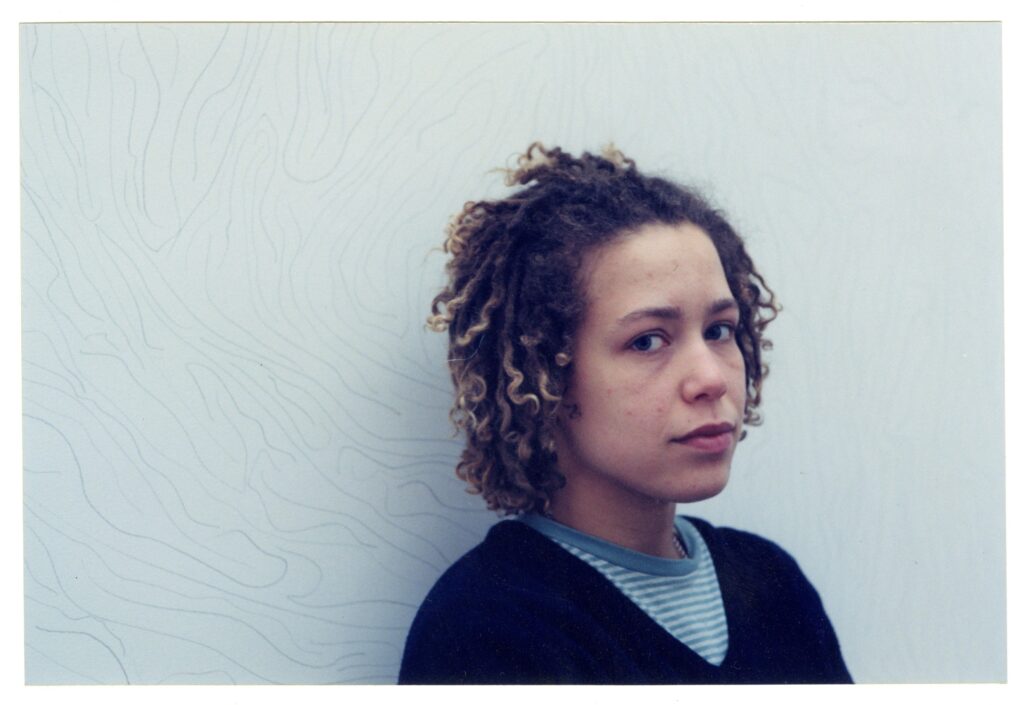
NAS: It was and it wasn’t. It wasn’t at first because I didn’t understand how much was at stake in being right. I was pretty green. I had a vision of what I thought lines not straight and not touching looked like, but when I saw other iterations of Lines, Not Straight, Not Touching [. . .] I realized, “Oh, that’s what they wanted that to look like. Whoops.” If you use the analogy that Sol LeWitt has written a piece of music and the orchestra is playing it, I was interpreting that music maybe a little bit too much in my own way.
I also didn’t understand that the weight of the hand with the graphite on the wall is supposed to be consistent. Mine was not.
Did you reference any previous LeWitt drawings?
NAS: I knew astonishingly little walking in there, which is maybe good and bad.
Would the studio representatives give direction?
NAS: There were managers giving directions, like, “Okay, this is what’s happening today. These people will do green here first, then at 6 p.m., after it dries, we’ll re-tape for the color in the other direction.”
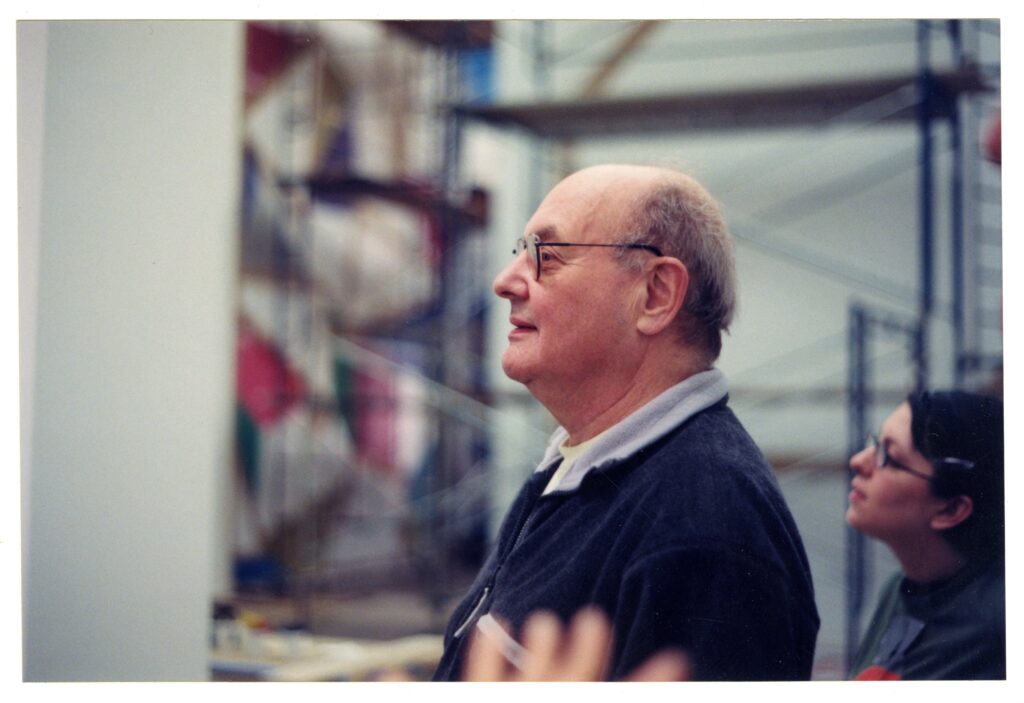
I remember some people were perhaps not pleased with how my work looked. I would see them come by, and I was like, “Okay, until they tell me to stop, I’ll just keep drawing.” At one point I could tell somebody was standing behind me, and I was like, “Oh, there’s another one.” I pulled off my headphones, turned around, and it was Sol LeWitt. He was standing there just looking at it and he said, “That looks really nice.” And then he walked away. I thought, “Okay, I guess it’s fine then.” Knowing now how these things run, I’m sure somebody said, “Sol, you better go look at what she’s doing.” Looking at other iterations of this wall drawing, I’m sure I didn’t do it the way everybody was picturing.
LeWitt provided directions that others execute, so isn’t your interpretation part of that process?
NAS: There is interpretation, but there’s also a look that all his works have. The people who work for him regularly understand what these have looked like over and over and over. And I’m saying all this with a fair amount of embarrassment, I wish I had known more what the vision was.
What did you learn from this experience?
NAS: Taping. We all did taping. With a piece like Loopy Doopy, which was in SFMOMA’s atrium for quite some time, there’s a process they use to tape off the lines. You put down a piece of tape, then put a piece of tape over that, following the curve and outline of the shape. Then you paint the wall color over it to seal the tape, then you go back over and you paint.
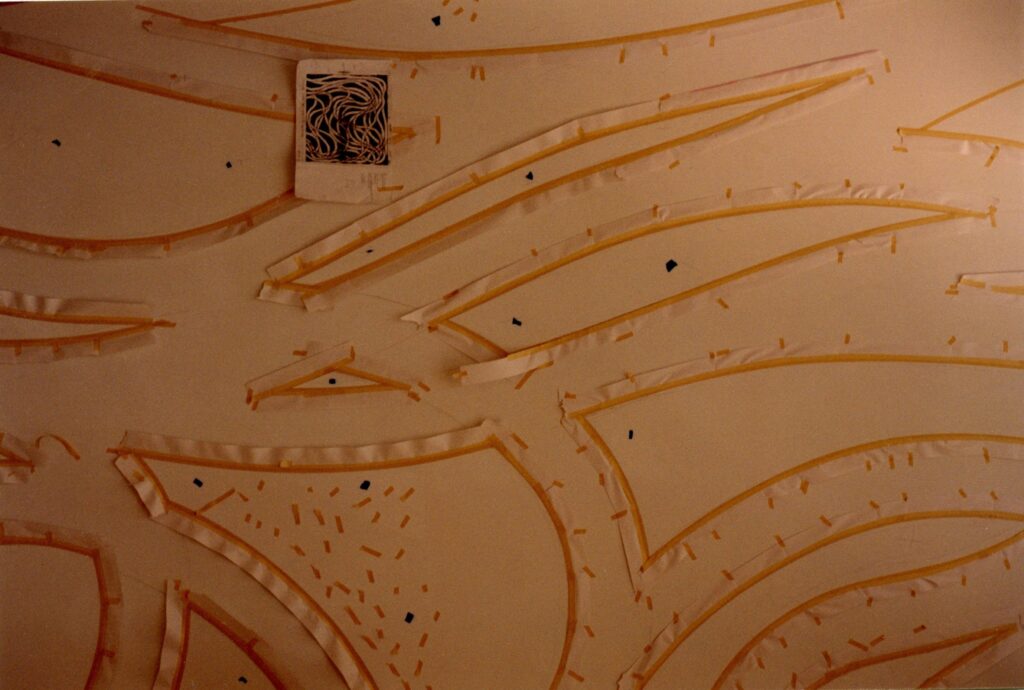
You would walk around with a piece of thick blue tape on your chest with a razor blade taped to it. When you got to the end of a line, you would hold up the razor blade and rip the paper. There were all these neat little techniques and tools that you end up creating. I learned how to tape off from that installation. There was something really meditative about it that I enjoyed. Years later, when my son had a design for his room that had zigzags and all this stuff, I used that technique.
I also gained an understanding of what it feels like to give yourself over to the work. In the mornings, I would think, “I just have to get to work. I just have to go draw more lines.” Your head gets buggy in a really amazing way where you’re in this other mindset. I learned a lot about LeWitt and his artwork in this in-depth way. I also saw what it’s like to be an artist’s assistant and what an amazing experience that would be. I was still pretty young, and it made a big impression.
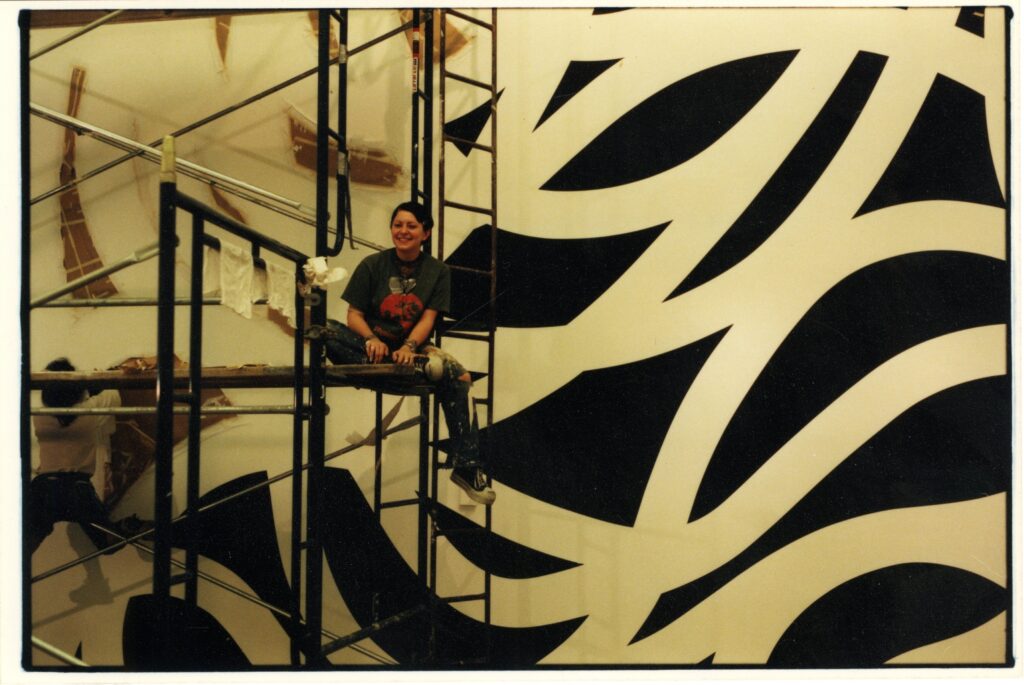
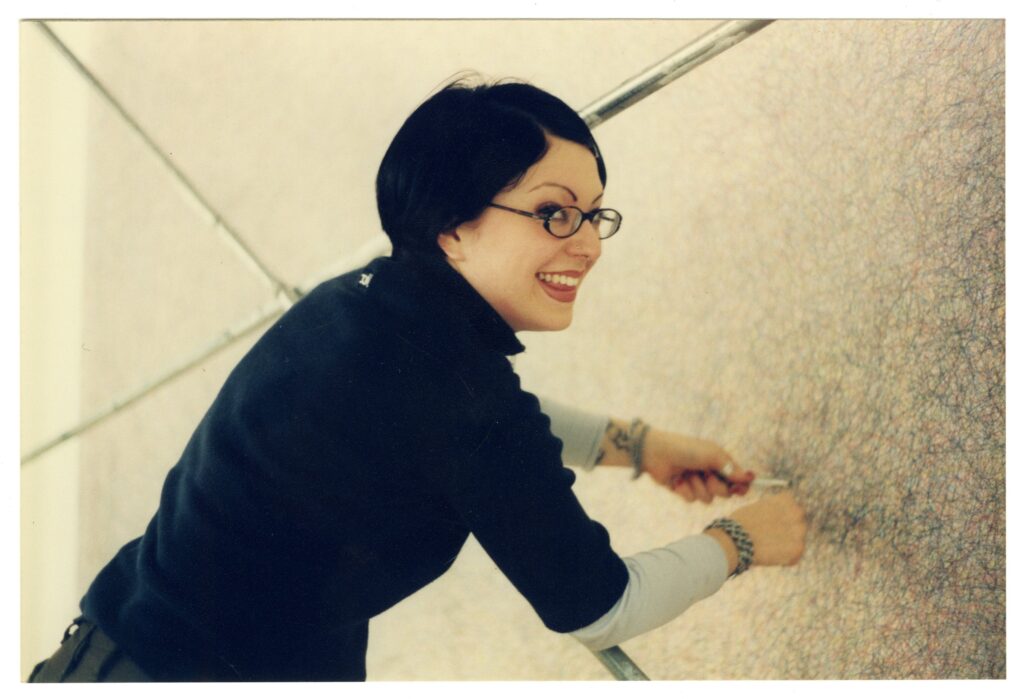
I did write Sol LeWitt a letter to say what an amazing experience it was. At Yerba Buena Center for the Arts, we were still mudding our own walls, so when I came in for this project, I was like, “We don’t have to mud and sand and prime and paint? We just walk in and these walls are pristine and ready to go?” To enter the room as part of that crew is pretty special. I had done house painting for many summers, and it’s the prep where all the cost and brutal work is. Not having to do wall prep was a big treat.
Do you have other special memories from the experience?
NAS: I remember there were people on his team who orchestrated the steps. Everything followed this very methodical production line. “This happens first, then this happens, then that happens.” They’ve got it down to how long it takes a particular kind of ink to dry and how long it takes whatever to happen. It’s an amazing process. And fun. I loved it.
When we were doing colored wall drawings, there was also one person whose job was to sharpen pencils. He just sat at a table with a manual pencil sharpener. He’d go around and around then set a pencil down, then he’d go around and around and set another one down. There would be these beautiful piles of perfectly colored pencil shavings. And the pencils they use are very nice — German Staedtler pencils or something like that.
I remember that LeWitt was a really nice person. He couldn’t be available to every person, but with every interaction, big or small, he was very kind, even keeled, and just no drama.
Working on this project was what made me go back to get my art degree. I had a bachelor’s degree, but I was like, “I have to go to art school. I want to just think about line.” It was five weeks, ten hours a day — I think I had two days off during that time. I focused on nothing else but line and shape and form and color. My head was just filled with it and I loved it. It changed my life.
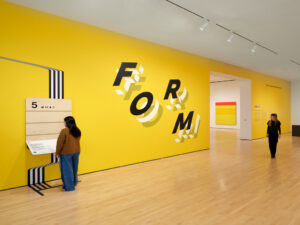
Calder, Kelly, LeWitt: Fundamentals of Form is part of Reimagined: The Fisher Collection at 10, on view beginning April 18, 2026, on Floor 5. Learn more at sfmoma.org/fisher-collection.
Visionary support for Reimagined: The Fisher Collection at 10 is provided by Fisher Art Foundation.
Lead support is provided by Penny S. and James G. Coulter and Mimi and Peter Haas Fund.
Presenting support is provided by Dana and Bob Emery.
Major support is provided by Katie Hall and Tom Knutsen.
Significant support is provided by Concepción S. and Irwin Federman, Alexandria and Kevin Marchetti, and Deborah and Kenneth Novack.
Meaningful support is provided by Alka and Ravin Agrawal, Sabrina Buell and Yves Béhar, Nancy and Alan Schatzberg, and Susan Swig.