The museum will be closed September 14–16, 2026 for a private event. The Museum Store will remain open to the public from 3rd Street.

The exhibition Memory and Matter: Personal and Collective Histories, part of Reimagined: The Fisher Collection at 10, features nearly a dozen works by South African artist William Kentridge (born 1955), whose nuanced and powerful explorations of colonialism, war, science, and literature defy genre. Learn how his longtime collaborator Sabine Theunissen uses her background in set design and architecture to create immersive environments for his stop-motion animated films, multimedia theatrical installations, and optically complex projections, along with interactive displays of his drawings and other materials that give insight into his process.
How did your collaboration with William Kentridge begin?
Sabine Theunissen: In 2002, he was invited by La Monnaie Opera House in Brussels to stage The Magic Flute by Mozart. At that time, I was a set and scenery assistant for the opera, and he needed someone who knew the opera house well and could support him technically and also artistically. Since then, we have never stopped working together — not only on theater projects but also installations and exhibitions
The first exhibition he asked me to design was for Beijing in 2015 [Notes for a Model Opera at UCCA Center for Contemporary Art]. It was a huge project, almost more architecture than exhibition design, because we built a floor, a staircase, a ramp, and ceilings. It was a huge, empty hall, and we had to build a museum inside it.
I’m so privileged to work with William. It’s really a beautiful partnership. I am also very lucky to work on both theater and exhibitions. When I do a theater production, I dream of doing an exhibition, and when I’m on an exhibition installation, I dream of doing a theater production. It’s very complimentary and rich to have both.
As a theater set designer, what skills and perspectives do you bring to Kentridge’s work? How does working on theater productions differ from museum exhibitions?
ST: My background is theater, but I’m also trained in architecture. I bring a relationship to space in terms of composition, dynamic, tension, transition, and movement through an environment.
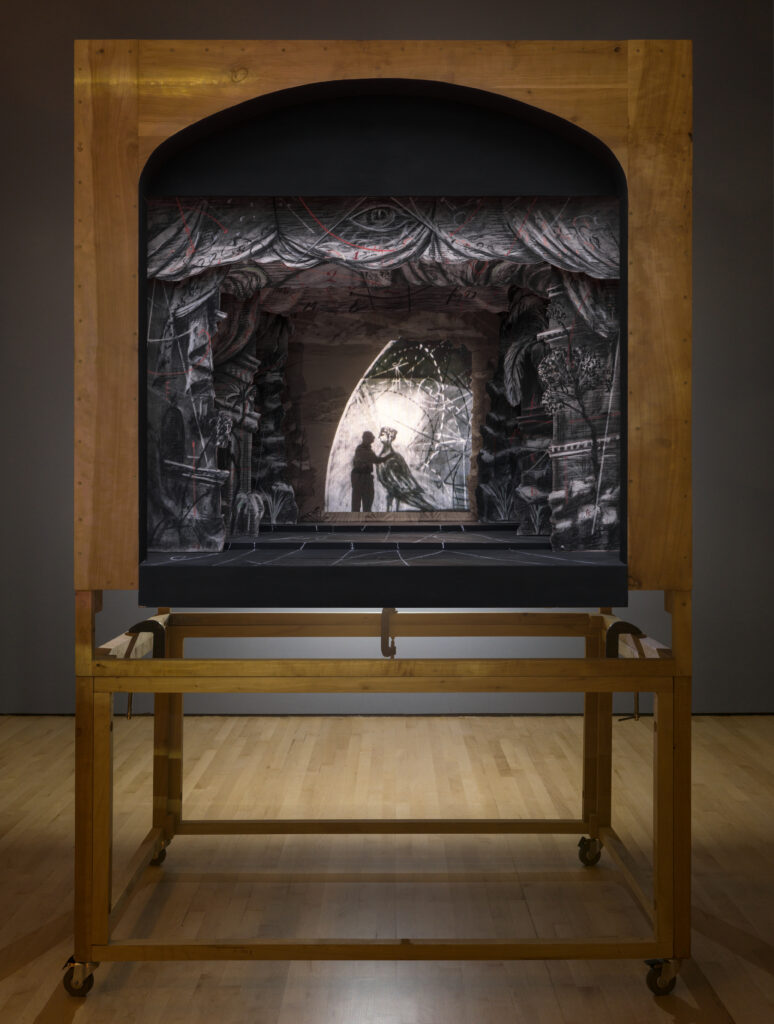
I also bring the sensibility to find connections and interactions between his work and video, with the real space and with the details, objects, texture, color, three-dimensionality. For example, we found together a very interesting way to give extra depth to his video and integrate the actors, the performers, the singers, the dancers. It’s also a question of scale. It’s very much about the third dimension and the transformation.
I’m interested in the transition from one moment to another, and it leads to questions of mechanics. How do you change a scene? You can use a curtain, but there are many other ways to do it. This magic of transformation needs a little bit of technology. In theater, we need machinery since the public is most often sitting, while in a museum exhibition, the transition happens naturally by the visitor moving in the space.
The progression and chapters of an exhibition are similar to theater or opera. There is a score, and you need landings and space in which to be overwhelmed or moved but also to rest, to focus. You need moments of community and moments on your own. You need to feel small, you need to feel big. All these perceptions are very important.
What is your process of working together?
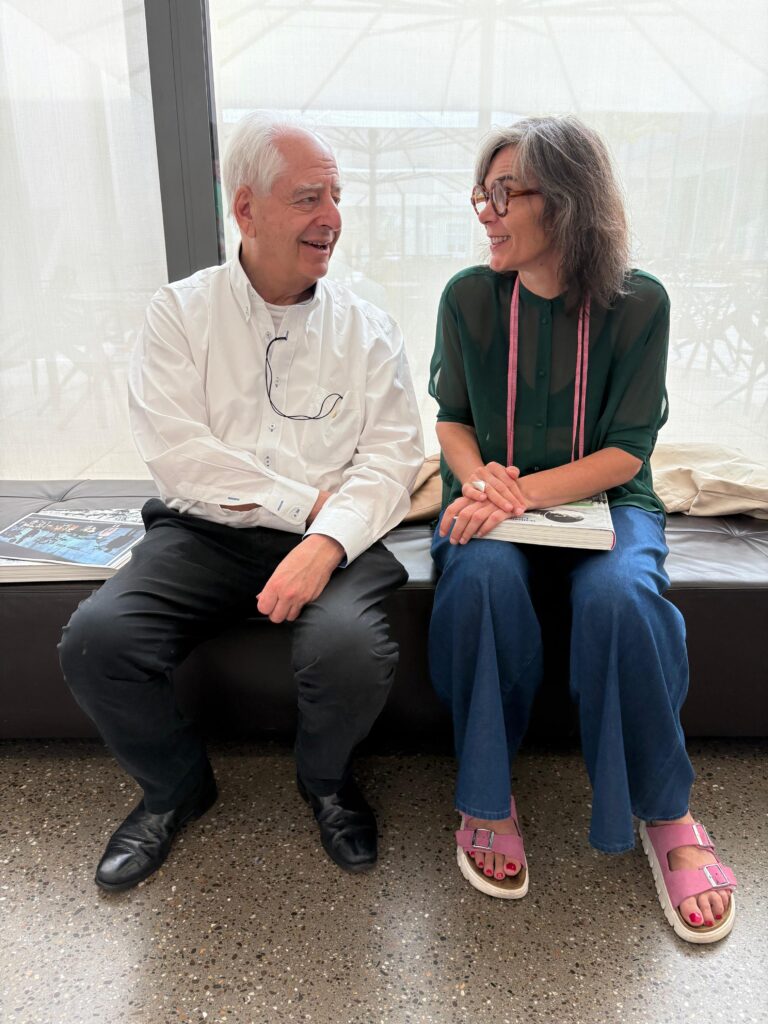
ST: We start early on with a physical cardboard model I bring. And he plays with this model; drawing, filming what he is doing, and projecting his drawing onto it. It is an interactive process — working alongside each other and thinking together and responding to each other.
For exhibitions, I regard my job as being between the curator, William, and the building to find the harmony and the score. It’s not so much hierarchy but more like, “let’s cook together.” And because I am quite familiar with William’s work after so many years, I can also propose alternatives or additions.
When you have a building, whatever the building is — it could be historical, beautiful, complicated, ugly, or uninspiring — at least you have these constraints as a starting point, and you find your way through what the building requires.
What are some of the features of the SFMOMA presentation?
ST: Sound is often a challenge with William’s exhibitions. I created three separate boxes to isolate the three sound pieces, with open space around them for visitors, with a set of tables for documents, and some domestic objects, like a lamp, a carpet, a chair. At the tables, people can sit and interact not only with the artwork but with each other.
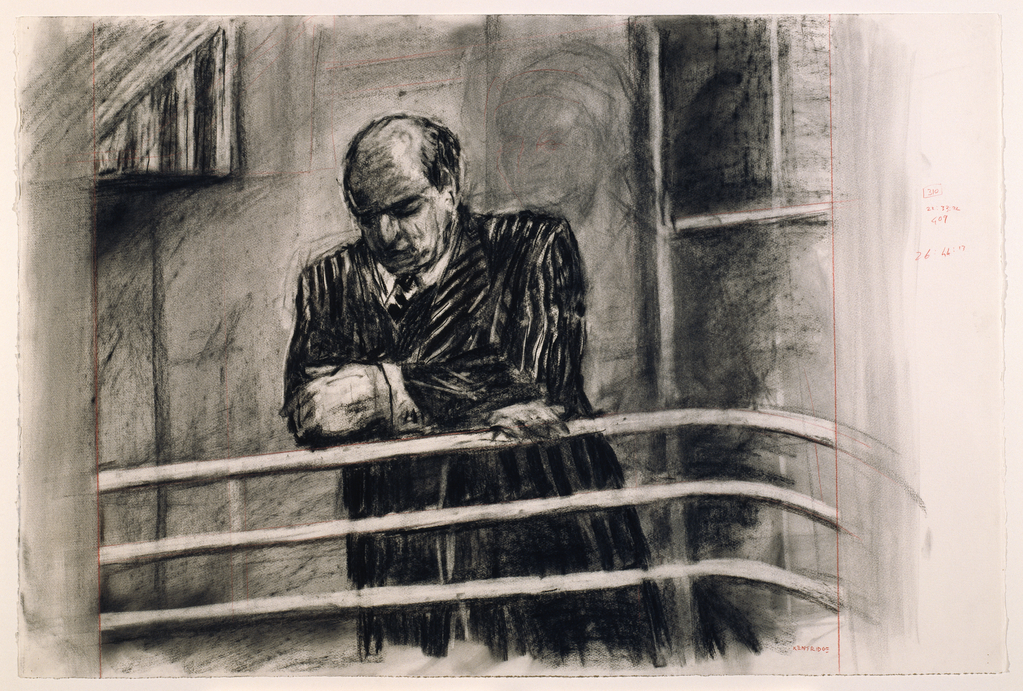
It evokes the worktable in William’s studio. I like to refer to the studio because I think it’s inspiring for the visitor to understand that the drawings you see on the wall come from a process, from the hand, charcoal, ink, a moment, a person. Especially knowing William’s technique for animation, like in Tide Table (2003). It’s not millions of drawings — it is the same drawing that he erases and redraws. What you see in the film doesn’t exist anymore.
“It’s important for me that the visitor is not only seeing and understanding but also feeling.”
Your designs for Kentridge’s exhibitions have always featured distinctive, sustainable materials, such as cork. What interests you about these materials?
ST: I don’t like to transform the materials that I use. I like to use them raw for their own, genuine qualities. The cork for me is a great response to the problem of finding a material that is light, cheap, a good sound barrier, good-looking, dark, and doesn’t need any plastering or finishing. It’s also very important for me as a designer to act as an eco-responsible person. Sometimes in an exhibition we are talking about two or three thousand square meters of material that is used for two or three months and then goes in the bin. I really want to find a solution. I am not there yet with everything, but I’m trying my best to reduce the ecological impact.
And as an architect, I like to be honest with what I’m doing. A wall is a wall, a box is a box, a floor is a floor. To expose the construction and the nature of the material is the grammar of my practice.
It’s also very important to bring a little bit of warmth into an exhibition. It’s not only visual or intellectual, but also sensorial. If you are in a cold and hard space, it influences your way of looking at things. If you want visitors to be comfortable, you need to create an atmosphere that feels cozy in a way.
What goals do you have for how the audience experiences the Kentridge works in the exhibition?
ST: I’m often intimidated in museums because you feel like you cannot touch, you cannot approach, you cannot belong. So I try to achieve the opposite. It’s important for me that the visitor is not only seeing and understanding but also feeling. We have art historians to handle the other parts; I’m on the side of how people feel.
Memory and Matter: Personal and Collective Histories is part of the Reimagined: The Fisher Collection at 10, on view beginning April 18, 2026, on Floor 6.
Learn more about the Fisher Collection.