Ownership History
San Francisco Museum of Modern Art, purchase through a gift of Phyllis Wattis, 1998
Exhibition History
Group Drawings, Poindexter Gallery, New York, December 19, 1955–January 4, 1956.
Black, White and Grey: Contemporary Painting and Sculpture, Wadsworth Atheneum, Hartford, Connecticut, January 9–February 9, 1964.
American Drawings, Solomon R. Guggenheim Museum, New York, September 17–October 27, 1964. Traveled to: University of Michigan, Ann Arbor, November 11–December 13, 1964; Grand Rapids Art Museum, Michigan, January 10–February 7, 1965; University Gallery, Northrop Auditorium, University of Minnesota, Minneapolis (as Contemporary American Drawings), February 24–March 24, 1965; Seattle Art Museum, Washington, April 8–May 2, 1965; Denver Art Museum, Colorado, June 6–July 3, 1965; Dallas Museum of Fine Arts, July 25–August 22, 1965; Columbus Gallery of Fine Arts, Ohio, September 16–October 10, 1965; Krannert Art Museum, University of Illinois, Urbana–Champaign, November 14–December 5, 1965.
Art in the Mirror, Museum of Modern Art, New York, November 22, 1966–February 5, 1967. Traveled to: Mansfield Fine Arts Guild Guild, Mansfield, Ohio, March 10–April 2, 1967; San Francisco State College, April 21–May 14, 1967; Los Angeles Municipal Art Gallery, June 27–July 23, 1967; Los Angeles Valley College, Van Nuys, California, September 22–October 15, 1967; Museum of Fine Arts, Houston, November 3–December 3, 1967; State University College, Oswego, New York, February 13–March 6, 1968.
Robert Rauschenberg: Selections, Fort Worth Art Center Museum, Fort Worth, Texas, January 5–February 2, 1969.
3D into 2D: Drawing for Sculpture, New York Cultural Center, New York, January 19–March 11, 1973. Did not travel to remaining venues.
Poets of the Cities: New York and San Francisco, 1950–1965, Dallas Museum of Fine Arts, November 20–December 29, 1974. Traveled to: San Francisco Museum of Art, January 31–March 23, 1975; Wadsworth Atheneum, Hartford, Connecticut, April 23–June 1, 1975.
Drawing Now, Museum of Modern Art, New York, January 23–March 9, 1976. Did not travel to remaining venues.
Robert Rauschenberg, National Collection of Fine Arts, Smithsonian Institution, Washington, D.C., October 30, 1976–January 2, 1977. Traveled to: Museum of Modern Art, New York, March 25–May 17, 1977; San Francisco Museum of Modern Art, June 24–August 21, 1977; Albright-Knox Art Gallery, Buffalo, September 25–October 30, 1977; Art Institute of Chicago, December 3, 1977–January 15, 1978.
Art about Art, Whitney Museum of American Art, New York, July 19–September 24, 1978. Traveled to: North Carolina Museum of Art, Raleigh, October 22–November 26, 1978; Frederick S. Wight Art Gallery, University of California, Los Angeles, December 17, 1978–February 11, 1979; Portland Art Museum, Oregon, March 6–April 15, 1979.
Robert Rauschenberg: Zeichnungen, Gouachen, Collagen: 1949–1979, Kunsthalle Tübingen, Germany, May 5–June 24, 1979. Traveled to: Kunstmuseum Hannover mit Sammlung Sprengel, Germany, August 19–September 23, 1979.
Rauschenberg: Werke 1950–1980, Staatliche Kunsthalle Berlin, March 23–May 4, 1980. Traveled to: Kunsthalle Düsseldorf, Düsseldorf, Germany, June 6–July 13, 1980; Louisiana Museum of Modern Art, Humlebæk, Denmark,September 20–November 25, 1980; Städelsches Kunstinstitut, Frankfurt, Germany, December 4, 1980–January 18, 1981; Städtische Galerie im Lenbachhaus, Munich, February 4–April 5, 1981; Tate Gallery, London (as Robert Rauschenberg), April 29–June 14, 1981 (on view through May 19, 1981).
Westkunst: Zeitgenössische Kunst seit 1939, Rheinhallen KölnMesse (organized by Museen der Stadt Köln), Cologne, Germany, May 30–August 16, 1981.
Rauschenberg, Fundación Juan March, Madrid, February 8–March 24, 1985. Traveled to: Fundació Joan Miró, Barcelona, March 28–May 19, 1985.
Übrigens sterben immer die anderen: Marcel Duchamp und die Avantgarde seit 1950, Museum Ludwig, Cologne, Germany, January 15–March 6, 1988.
L’art conceptuel, une perspective, Musée d’Art Moderne de la Ville de Paris, November 22, 1989–February 18, 1990. Traveled to: Fundación Caja de Pensiones, Madrid (as Arte conceptual, una perspectiva), March 12–April 29, 1990. Did not travel to remaining venues.
Robert Rauschenberg: The Early 1950s, Corcoran Gallery of Art, Washington, D.C., June 15–August 11, 1991. Traveled to: The Menil Collection, Houston, September 27, 1991–January 5, 1992; Museum of Contemporary Art, Chicago, February 8–April 19, 1992; San Francisco Museum of Modern Art, May 14–August 16, 1992 (on view until around June 5, 1992). Did not travel to Guggenheim Museum SoHo, New York.
Territorium Artis, Kunst- und Ausstellungshalle der Bundesrepublik Deutschland, Bonn, Germany, June 19–September 20, 1992.
Rolywholyover a Circus, Museum of Contemporary Art, Los Angeles, September 12–November 28, 1993. Traveled to: The Menil Collection, Houston, January 14–April 2, 1994; Guggenheim Museum SoHo, New York, April 23–July 31, 1994. Did not travel to remaining venues.
Duchamp’s Leg, Walker Art Center, Minneapolis, November 5, 1994–March 26, 1995. Did not travel to Center for the Fine Arts, Miami, Florida.
Identità e alterità: figure del corpo 1895–1995, 47th Biennale di Venezia, Palazzo Grassi, Venice, Italy, June 11–October 15, 1995.
Robert Rauschenberg: A Retrospective, Solomon R. Guggenheim Museum, New York, September 19, 1997–January 7, 1998. Traveled to: The Menil Collection, Houston, February 13–May 17, 1998; Museum Ludwig, Cologne, Germany, June 27–October 11, 1998; Guggenheim Museum Bilbao, Spain, November 21, 1998–March 7, 1999.
Robert Rauschenberg, San Francisco Museum of Modern Art, May 7–September 7, 1999.
The American Century: Art and Culture 1900–2000, Part II, 1950–2000, Whitney Museum of American Art, New York, September 26, 1999–February 13, 2000.
Points of Departure: Connecting with Contemporary Art, San Francisco Museum of Modern Art, March 23–October 28, 2001.
Robert Rauschenberg at SFMOMA, San Francisco Museum of Modern Art, June 27–September 8, 2002.
Treasures of Modern Art: The Legacy of Phyllis Wattis at SFMOMA, San Francisco Museum of Modern Art, January 30–June 24, 2003.
Target Practice: Painting Under Attack: 1949–78, Seattle Art Museum, June 25–September 7, 2009.
75 Years of Looking Forward: The Anniversary Show, San Francisco Museum of Modern Art, December 19, 2009–January 16, 2011 (on view through June 29, 2010).
50 Years at Pace: The Abstract Expressionist and Pop Art Years, Pace Gallery, New York, September 17–October 23, 2010.
Damage Control: Art and Destruction Since 1950, Hirshhorn Museum and Sculpture Garden, Smithsonian Institution, Washington, D.C., October 24, 2013–May 26, 2014. Did not travel to remaining venues.
The Drawing Biennial, The National Museum of Art, Architecture and Design, Oslo, October 10–November 23, 2014.
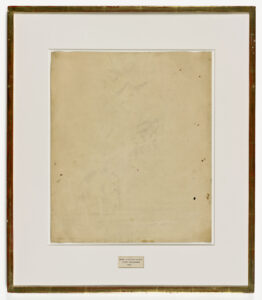
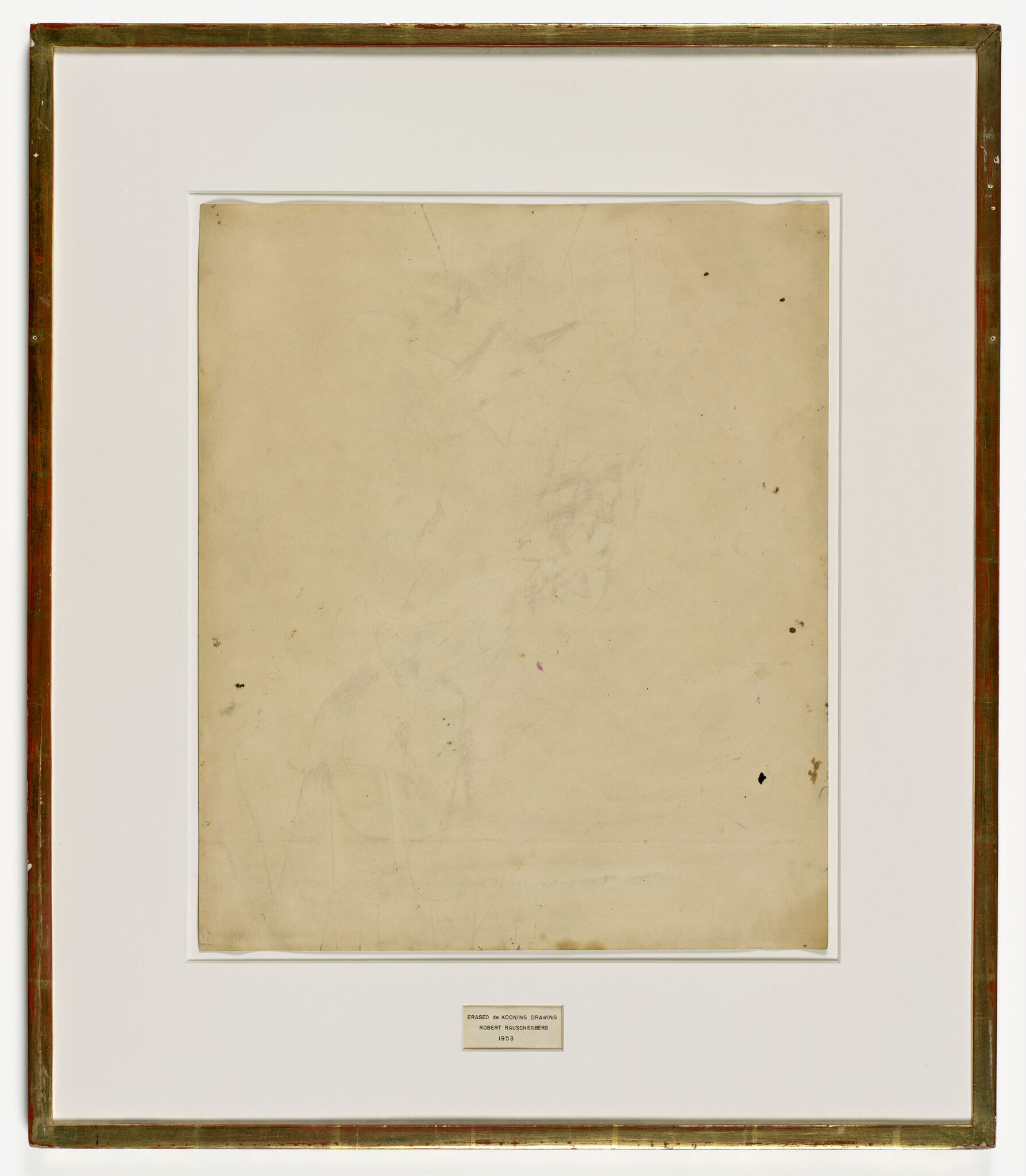
In addition to appearing in the special exhibition listed above, Erased de Kooning Drawing was shown in SFMOMA’s galleries in 1999, 2000, 2004, 2005, 2006, 2008, and 2016 as part of a series of rotating presentations of the permanent collection.
This listing has been updated since the launch of the Rauschenberg Research Project and is complete as of August 31, 2016.
Publication History
Yoshiaki Tono, “From a Gulliver’s Point of View,” Art in America 48, no. 2 (Summer 1960): 58.
John Cage, “On Robert Rauschenberg, Artist, and his Work” Metro 2 (May 1961): 41.
———, “Om Robert Rauschenberg, konstnär, och hans arbete,” Konstrevy 37, no. 5–6 (1961): 168.
———, Silence: Lectures and Writings by John Cage (Middletown, CT: Wesleyan University Press, 1961), 101.
American Drawings (New York: Solomon R. Guggenheim Museum, 1964), n.p.
Huntington Hartford, Art or Anarchy? (Garden City, NY: Doubleday, 1964), 35.
Max Kozloff, “The Impact of de Kooning,” Arts Yearbook 7 (1964): 77, 79–80, 83.
Bryan Robertson, Henry Geldzahler, and John Cage, Robert Rauschenberg: Paintings, Drawings and Combines, 1949–1964 (London: Whitechapel Gallery, 1964), 10.
Florence Berkman, “Pop Art on Exhibition Free, Far Out,” Hartford Times, January 11, 1964.
Calvin Tomkins, “Profiles: Moving Out,” New Yorker, February 29, 1964, 66, 71.
“Most Happy Fella,” Time, September 18, 1964, 84.
Brian O’Doherty, “Vanity Fair: The New York Art Scene,” Newsweek, January 4, 1965, 58.
“Drawing Affords a Certain Freedom,” Minneapolis Tribune, March 7, 1965.
Al McConagha, “Rauschenberg Wants to Open People’s Eyes,” Minneapolis Tribune, May 9, 1965.
Donald Finkel, A Joyful Noise: Poems by Donald Finkel (New York: Atheneum, 1966), 62–69.
Lucy R. Lippard, Pop Art (New York: Frederick A. Praeger, 1966), 23.
Allan Kaprow, “Experimental Art,” ARTnews 65, no. 1 (March 1966): 63.
Richard Kostelanetz, “The Artist as Playwright and Engineer,” New York Times, October 9, 1966, 122, 124.
“‘Art in the Mirror’: Pop Art Exhibit Kids Tired Old Cliches,” Florence Morning News (Florence, SC), December 18, 1966.
John Cage, A Year from Monday: New Lectures and Writings (Middletown, CT: Wesleyan University Press, 1967), 71, 75.
Alan Solomon, New York: The New Art Scene (New York: Holt, Rinehart and Winston, 1967), 42.
Henry J. Seldis, “‘Mirror’ Exhibit Unrevealing,” Los Angeles Times (Calendar), July 2, 1967.
Gregory Battcock, Minimal Art: A Critical Anthology (New York: E. P. Dutton, 1968), 298, 299.
Nicolas Calas, Art in the Age of Risk, and Other Essays (New York: E. P. Dutton, 1968), 182.
Harold Rosenberg, Artworks and Packages (New York: Horizon Press, 1968), 24, 25 (ill.), 26.
Lucy R. Lippard and John Chandler, “The Dematerialization of Art,” Art International, February 20, 1968, 32.
“Lärm im Spiegel,” Der Spiegel, May 6, 1968, 153.
Andrew Forge, Rauschenberg (New York: Harry N. Abrams, 1969), 7, 25.
Richard Kostelanetz, Master Minds: Portraits of Contemporary American Artists and Intellectuals (New York: Macmillan, 1969), 269.
John Russell and Suzi Gablik, Pop Art Redefined (London: Thames and Hudson, 1969), 11 (ill.).
Robert M. Adams, “Ssh,” New York Review of Books, September 25, 1969, 30.
William Wilson, “‘Rauschenberg Black and White’ at Newport Harbor,” Los Angeles Times (Calendar), December 28, 1969.
Lawrence Alloway, “Robert Rauschenberg et Jasper Johns,” Depuis 45—L’art de notre temps 2 (Bruxelles: La Connaissance, 1970), 201.
Frank Stella: A Retrospective Exhibition (London: Hayward Gallery, 1970), n. p.
Irving H. Sandler, “Rauschenberg and Johns: Anti-Art?,” New York Times, May 10, 1970.
Kendall L. Walton, “Categories of Art,” Philosophical Review 79, no. 3 (July 1970): 335.
Lucy R. Lippard, Changing: Essays in Art Criticism (New York: E. P. Dutton, 1971), 261.
Peter Schjeldahl, “Rauschenberg Just Won’t Be Boxed In,” New York Times, October 31, 1971.
Painters Painting: A Candid History of the New York Art Scene, 1940–1970, directed by Emile de Antonio (New York: Turin Film, 1972), DVD, 116 min. Distributed by New Video in 2010.
Lucy R. Lippard, Tony Smith (New York: Harry N. Abrams, 1972), 24.
Harold Rosenberg, The De-Definition of Art (New York: Collier Books, 1972), 111, 124.
Leo Steinberg, “Reflections on the State of Criticism,” Artforum 10, no. 7 (March 1972): 47.
3D into 2D (New York: New York Cultural Center, 1973), 4, 31.
James R. Mellow, “‘3D into 2D’: Drawings by Sculptors,” New York Times, January 27, 1973.
Douglas Crimp, “New York Review,” Art International 17, no. 4 (April 1973): 57, 58.
Neil A. Chassman, Robert M. Murdock, Lana Davis, et al., Poets of the Cities: New York and San Francisco 1950–1965 (Dallas: Dallas Museum of Fine Arts, 1974), 32, 35, 41, 76 (ill.), 169.
Albert William Levi, “The Poverty of the Avant Garde,” Journal of Aesthetic Education 8, no. 4 (October 1974), 14.
Monroe C. Beardsley, “The Faith of Graffiti,” Journal of Aesthetics and Art Criticism 33, no. 3 (Spring 1975): 374.
Walter Hopps, ed., Robert Rauschenberg (Washington, D.C.: National Collection of Fine Arts, Smithsonian Institution, 1976), 75 (ill.).
Bernice Rose, Drawing Now (New York: Museum of Modern Art, 1976), 8 (ill.), 12.
Calvin Tomkins, The Bride and the Bachelors: Five Masters of the Avant-Garde (New York: Penguin, 1976): 210–11.
Stephanie Barron, Los Angeles County Museum of Art Bulletin 22 (1976): 66, 67 (ill.).
Stephen Mark Dobbs, “Buck Rogers to Buckminster Fuller: On the Future of Art,” Art Education 29, no. 3 (March 1976): 10.
Harold Rosenberg, “The Art World: American Drawing and the Academy of the Erased de Kooning,” New Yorker, March 22, 1976, 107–8.
Maxime de la Falaise McKendry, “Robert Rauschenberg Talks to Maxime de la Falaise McKendry,” Andy Warhol’s Interview 6, no. 5 (May 1976): 36.
Paul Richard, “‘Goofy, Grand’ Rauschenberg,” Washington Post, October 30, 1976.
Robert Hughes, “The Most Living Artist,” Time, November 29, 1976, 61.
Lorraine Haacke, “‘Happening’ Underway for Television Age,” Dallas Times Herald, December 19, 1976.
Benjamin Forgey, “An Artist for all Decades,” ARTnews 76, no. 1 (February 1977): 47.
Charles F. Stuckey, “Reading Rauschenberg,” Art in America 65, no. 2 (March–April 1977): 79.
Grace Glueck, “Art People,” New York Times, March 25, 1977.
“Robert Rauschenberg: Between Art and Life,” MoMA Bulletin, no. 2 (Spring 1977): 1.
Carter Ratcliff, “New York,” Art International 21, no. 3 (May–June 1977): 60, 61.
Harold Rosenberg, “The Art World: Souvenirs of an Avant-Garde,” New Yorker, May 16, 1977, 124–25, 126.
Walter Blum, “A One-Man Mainstream,” San Francisco Examiner and Chronicle, June 19, 1977.
“Major Show of Rauschenberg’s Art Opens in SF,” Palo Alto Times, June 24, 1977.
“Rauschenberg Exhibition Opens at Museum of Modern Art,” San Jose News, June 24, 1977.
Arthur Bloomfeld, “Art of the Enfant Terrible,” San Francisco Examiner, June 24, 1977.
Blake Green, “A Portrait of Artist as Big Success,” San Francisco Chronicle, June 25, 1977.
Peter Hassinger, “Rauschenberg in San Francisco,” California (July 1977): 74.
Charles Shere, “The Ripening of Robert Rauschenberg—A Retrospective,” Oakland Tribune, July 3, 1977.
Julia Cheever, “Looking Back on a Giant of Modern Art,” San Francisco Bay Guardian, July 14, 1977.
Henry J. Seldis, “Rauschenberg Retrospective: Robert’s Rules of Disorder,” Los Angeles Times, July 24, 1977.
Steven Simmons, “American Collage: Robert Rauschenberg,” San Francisco Sentinel, July 28, 1977, 11.
Judith L. Dunham, “Rauschenberg’s Retrospective—Works Worth the Reading,” Artweek, July 30, 1977, 20.
Moira Roth, “Aesthetic of Indifference,” Artforum 16, no. 3 (November 1977): 50, 52 (ill.).
Dean Jensen, “Rauschenberg Retrospective Stupendous! Gargantuan!,” Sentinel (Chicago), December 1977.
Franz Schulze, “Rauschenberg’s Cheerful Cheek,” Chicago Daily News, December 3–4, 1977.
Jean Lipman and Richard Marshall, Art about Art (New York: Whitney Museum of American Art, 1978), 142, 147 (ill.).
Irving H. Sandler, The New York School: The Painters and Sculptors of the Fifties (New York: Harper & Row, 1978), 173n46, 177.
Stuart Morgan, “About Art about Art,” Arts Magazine 53, no. 1 (September 1978): 149.
Robert Rauschenberg: Retrospective, directed by Michael Blackwood (New York: Michael Blackwood Productions, 1979), VHS, 45 min.
Götz Adriani, Robert Rauschenberg: Zeichnungen, Gouachen, Collagen 1949 bis 1979 (Munich: R. Piper & Co. Verlag, 1979), 11, 176.
Arthur Perry, “Rauschenberg Meets Standard in Exhibition,” Artmagazine (Toronto) 11, no. 45 (September/October 1979): 42.
Roger Copeland, “The Politics of Perception,” New Republic, November 17, 1979, 26.
Robert M. Adams, The Lost Museum: Glimpses of Vanished Originals (New York: Viking Press, 1980), 11.
Calvin Tomkins, Off the Wall: Robert Rauschenberg and the Art World of Our Time (Garden City, NY: Doubleday, 1980), 96–97, 299.
Camilla Blechen, “Inmitten der Bilderflut,” Du (Zürich) 6 (June 1980): 80.
Ursula Giessler, “Oder man nehme ein Bett,” Saarbrucker Zeitung, December 17, 1980.
Michael Compton, Robert Rauschenberg (London: Tate Gallery Publications, 1981), n.p.
Laszlo Glozer, Westkunst: Zeitgenössiche Kunst seit 1939 (Cologne: DuMont Buchverlag Köln, 1981), 23 (ill.), 433 (ill.).
Carter Ratcliff, “Mostly Monochrome,” Art in America 69, no. 4 (April 1981): 120 (ill.), 122.
Antonia Phillips, “Cleaning Up,” Times Literary Supplement (London), May 22, 1981, 572.
Michael Newman, “Rauschenberg Re-Evaluated,” Art Monthly no. 47 (June 1981): 9.
Benjamin H. D. Buchloh, “Allegorical Procedures: Appropriation and Montage in Contemporary Art,” Artforum 11, no. 1 (September 1982): 43 (ill.), 46.
Roger Copeland and Marshall Cohen, eds., What Is Dance? (New York: Oxford University Press, 1983), 309.
Emile de Antonio and Mitch Tuchman, Painters Painting (New York: Abbeville Press, 1984), 91–92.
Pierre Daix, “Rauschenberg à la Fondation Maeght,” Désirs des arts, June 3, 1984 (Paris: Antenne 2): 26:29 min. Discussion of Erased de Kooning begins at 11:14 min.
Rauschenberg (Madrid: Fundación Juan March, 1985), n.p. (ill.).
Sam Hunter, Selections from the Ileana and Michael Sonnabend Collection: Works from the 1950s and 1960s (Princeton, NJ: Princeton University Art Museum, 1985), 21, 76.
Donna Tennant, “Houston: Robert Rauschenberg—Contemporary Arts Museum,” ARTnews 85, no. 4 (April 1986): 141.
Barbara Rose, An Interview with Robert Rauschenberg (New York: Vintage Books, 1987), 51.
The Menil Collection: A Selection from the Paleolithic to the Modern Era, 1st ed. (New York: Harry N. Abrams, 1987), 276.
Maryln Schwartz, “Portrait of an Artist as a Sibling and a Son,” Dallas Morning News, January 25, 1987.
Übrigens sterben immer die anderen: Marcel Duchamp und die Avantgarde seit 1950 (Cologne: Museum Ludwig, 1988), 245, 331.
Claude Gintz, et al., L’art conceptual, une perspective, trans. Judith Aminoff (Paris: Musée d’Art Moderne de la Ville de Paris, 1989), 15, 21, 223 (ill.).
John Cage, Michel Nuridsany, Nina Sundell, et al., Robert Rauschenberg (Paris: Galerie Fabien Boulakia, 1990), 12, 68.
Antoine Compagnon, Les cinq paradoxes de la modernité (Paris: Éditions du Seuil, 1990), 125.
Roni Feinstein, “Random Order: The First Fifteen Years of Robert Rauschenberg’s Art, 1949–1964” (PhD diss., New York University, 1990), v, 140–46, 182n7, 183n8, 331, 342n60, 489.
Mary Lynn Kotz, Rauschenberg, Art and Life (New York: Harry N. Abrams, 1990), 82, 108, 187, 251, 262.
———, “Quiet House,” Museum & Arts Washington 6, no. 6 (November/December 1990): 77.
Philip Fisher, Making and Effacing Art: Modern American Art in a Culture of Museums (New York: Oxford University Press, 1991), 98–99.
Walter Hopps, Robert Rauschenberg: The Early 1950s (Houston: Menil Collection and Houston Fine Art Press, 1991), 160, 161, 162, 168, 201 (ill.).
———, Robert Rauschenberg: The Early 1950s (Houston: Menil Foundation, 1991), 8, 27, 37. Produced for the Menil presentation only.
Paul Richard, “Silk Sheets and Neon Bicycles; At the National Gallery, the Extravagant ‘Rauschenberg Overseas Culture Interchange,’” Washington Post, May 12, 1991.
Jo Ann Lewis, “Rauschenberg, Bright and Early; Accomplished Works of the Young Artist, at the Corcoran,” Washington Post, June 15, 1991.
“A Close-Up of an Artist’s Evolution at Corcoran,” Washington Times, June 24, 1991.
Donald J. Saff, “Conservation of Matter: Robert Rauschenberg’s Art of Acceptance,” Aperture, no. 125 (Fall 1991): 30.
Pontus Hultén, Territorium Artis (Bonn, Germany: Verlag Gerd Hatje, 1992), 282, 283 (ill.), 383.
Jeanne Siegel, Artwords: Discourse on the 60s and 70s (New York: Da Capo Press, 1992), 3, 18.
Fred Camper, “The Unordered Universe,” Chicago Reader, March 26–April 1, 1992, 30, 31–32.
Frances Colpitt, “Rauschenberg: In the Beginning,” Art in America 80, no. 4 (April 1992): 128.
Roger Bevan, “San Francisco: Salvaging 1950s Rauschenberg,” Art Newspaper 3, no. 18 (May 1992): 7.
Lynne Cooke, “Robert Rauschenberg: The Early 1950s,” Burlington Magazine 134, no. 1070 (May 1992): 336.
Kenneth Baker, “A ’50s Look at Robert Rauschenberg,” San Francisco Chronicle, May 15, 1992.
Christopher Knight, “Enlightening Look at Early Rauschenberg,” Los Angeles Times, May 20, 1992.
Jerome Tarshis, “Creativity Knew No Limits,” Christian Science Monitor, September 14, 1992, 16.
Michael Kimmelman, “Before Rauschenberg Was Infamous,” New York Times, October 23, 1992.
Helen L. Kohen, “Matisse Leads Packed Museum Season,” Miami Herald (Florida), November 8, 1992.
Kay Larson, “Zen and the Art,” New York Magazine, November 16, 1992, 90.
Peinture: Emblèmes et références (Bordeaux: CAPC Musée d’Art Contemporain de Bordeaux, 1993), 14–15, 139.
ラウシェンバーグ [Rauschenberg], Gendai bijutsu 14 (Tokyo: Kodansha, 1993), n.p. (ill.).
Whitney Chadwick and Isabelle de Courtivron, eds., Significant Others: Creativity and Intimate Partnership (New York: Thames and Hudson, 1993), 196.
Christos M. Joachimides and Norman Rosenthal, eds., American Art in the 20th Century: Paintings and Sculpture, 1913–1993 (Munich: Prestel Verlag, 1993), 117 (ill.).
Seiji Oshima, Marjorie Welish, Takeshi Yoshizumi, et al., The Second Hiroshima Art Prize: Robert Rauschenberg (Hiroshima: Hiroshima City Museum of Contemporary Art, 1993), 38, 42.
Mark Swed, “Cage by Chance,” New Yorker, October 4, 1993, 212.
Antoine Compagnon, The Five Paradoxes of Modernity, trans. Franklin Philip (New York: Columbia University Press, 1994), 97.
Francis M. Naumann, “The Legacy of Marcel Duchamp,” Burlington Magazine 137, no. 1103 (February 1995): 138.
Thierry de Duve, Clement Greenberg between the Lines: Including a Previously Unpublished Debate with Clement Greenberg, trans. Brian Holmes (Paris: Éditions Dis Voir, 1996), 74, 79.
Jill Johnston, Jasper Johns: Privileged Information (London: Thames and Hudson, 1996), 135, 309n47.
Kristine Stiles and Peter Selz, eds., Theories and Documents of Contemporary Art: A Sourcebook of Artists’ Writings (Berkeley: University of California Press, 1996), 804.
The Menil Collection: A Selection from the Paleolithic to the Modern Era, 2nd ed. (New York: Harry N. Abrams, 1997), 276.
Robert Rauschenberg: Man at Work, directed by Chris Granlund (London: BBC and RM ARTS, 1997), DVD, 57 min.
Cornelia Faist, Catherine Craft, Billy Klüver, et al., Robert Rauschenberg: Haywire: Major Technological Works of the 1960s (Ostfildern-Ruit: Verlag Gerd Hatje, 1997), 24, 39n38.
Dario Gamboni, The Destruction of Art: Iconoclasm and Vandalism since the French Revolution (New Haven, CT: Yale University Press, 1997), 268, 269 (ill.).
Walter Hopps and Susan Davidson, eds., Robert Rauschenberg: A Retrospective (New York: Solomon R. Guggenheim Museum, 1997), 41n18, 44, 92 (ill.), 221n18.
Bernice Rose, Rauschenberg: Arcadian Retreats (New York: PaceWildenstein, 1997), 10.
Yve-Alain Bois, “Early Lead,” Artforum 36, no. 1 (September 1997): 97.
Thomas Crow, “This Is Now: Becoming Robert Rauschenberg,” Artforum 36, no. 1 (September 1997): 96, 98.
Dave Hickey, “Open Charms,” Artforum 36, no. 1 (September 1997): 101, 152.
Annick Colonna-Césari, “Rauschenberg, l’explorateur des limites,” L’express, September 10, 1997.
Elisabeth Lebovici, “Rauschenberg à grande échelle,” Libération, September 30, 1997.
Jeffrey Kastner, “Art Attack,” ARTnews 96, no. 9 (October 1997): 155, 156 (ill.).
Lynn Barber, “Robert Rauschenberg,” Observer Life Magazine (London), October 26, 1997, 12 (ill.).
Mario Naves, “A World without Distinctions: Rauschenberg at the Guggenheim,” New Criterion 16, no. 3 (November 1997): 47, 48.
Arthur C. Danto, “Robert Rauschenberg,” The Nation, November 17, 1997, 35.
Jed Perl, “Transformations,” New Republic, December 1, 1997, 34.
Tony Godfrey, Conceptual Art (London: Phaidon, 1998), 62 (ill.), 63–64, 75, 81, 165.
Jen Scoville, “Rauschenberg’s Repartee: Facetious Facets of the Retrospective in Houston,” Texas Monthly, 1998. Accessed June 23, 2013. https://www.texasmonthly.com/story/rauschenberg%E2%80%99s-repartee.
Roni Feinstein, “Rauschenberg: Solutions for a Small Planet,” Art in America 86, no. 2 (February 1998): 69.
Shaila Dewan, “Culture Clash,” Houston Press, February 26, 1998.
Janet Tyson, “Robert Rauschenberg reste saisi,” Le journal des arts, March 13, 1998.
Michael Barnes, Shermakaye Bass, Christopher Schade, and Jeanne Claire Van Ryzin, “Art Log: The Road to Rauschenberg, A Critical Junket,” Austin American-Statesman (Texas), March 26, 1998.
Jonathan Fineberg, “Robert Rauschenberg’s ‘Reservoir,’” American Art 12, no. 1 (Spring 1998): 87.
Jeffrey Kastner, “Houston: Sins of Commission?,” ARTnews 97, no. 4 (April 1998): 51.
Carol Vogel, “Inside Art: Left Their Art in San Francisco,” New York Times, June 5, 1998.
Diane Haithman, “S.F. Museum of Modern Art Goes on a Buying Spree,” Los Angeles Times, June 6, 1998.
Kenneth Baker, “Rauschenberg’s Reality,” San Francisco Chronicle, August 20, 1998, (ill.).
Tim Marlow, “Robert Rauschenberg,” Tate: The Art Magazine 16 (Winter 1998): 46.
Neal Benezra and Olga M. Viso, Regarding Beauty: A View of the Late Twentieth Century (Washington, D.C.: Hirshhorn Museum and Sculpture Garden, Smithsonian Institution, 1999), 28–29, 31 (ill.).
Robert Rauschenberg, video interview by David A. Ross, Walter Hopps, Gary Garrels, and Peter Samis, San Francisco Museum of Modern Art, May 6, 1999. Unpublished transcript, SFMOMA Research Library and Archives, N 6537 .R27 A35 1999a, 2, 20–24, 38.
Lisa Phillips, ed., The American Century: Art and Culture 1950–2000 (New York: Whitney Museum of American Art, 1999), 83 (ill.).
Daniel A. Siedell, “The Visual Culture of Robert Rauschenberg,” Sheldon Museum of Art Catalogues and Publications, 1999. Accessed June 23, 2013. https://digitalcommons.unl.edu/sheldonpubs/75.
Marjorie Welish, Signifying Art: Essays on Art after 1960 (Cambridge: Cambridge University Press, 1999), 289n24.
Kenneth Baker, “Rauschenberg Coup at SFMOMA: ‘Port of Entry’ a Major New Work,” San Francisco Chronicle, May 8, 1999.
David Bonetti, “Rauschenberg Coup Cements SFMOMA’s Ascendance,” San Francisco Examiner, May 28, 1999.
Sylvia Tan, “Tracks of Time,” San Francisco Bay Guardian, August 25, 1999.
Dave Hickey, “Apogamy Pods: Rauschenberg Erases Rauschenberg,” Apogamy Pods (New York: PaceWildenstein, 2000), 4 (ill.), 5.
Leo Steinberg, Encounters with Rauschenberg (Houston: Menil Foundation, 2000), vi, 16, 17 (ill.), 18–23, 38, 72n10.
Christine Temin, “‘Art’ and Art—Thoughts on White Matter and Its Value,” Boston Globe, March 8, 2000.
Branden W. Joseph, “Blanc sur blanc: Robert Rauschenberg et John Cage,” Les Cahiers du Musée national d’art moderne, no. 71 (Spring 2000): 20, 21 (ill.), 22.
———, “White on White,” Critical Inquiry 27, no. 1 (Autumn 2000): 113–15.
Charlie Finch, “Rauschenberg’s Long Goodbye,” Artnet, December 8, 2000. Accessed June 23, 2013. https://www.artnet.com/Magazine/reviews/finch/finch12-8-00.asp#6.
William Kentridge (Chicago: Museum of Contemporary Art, 2001), 20 (ill.), 21.
James Meyer, Minimalism: Art and Polemics in the Sixties (New Haven, CT: Yale University Press, 2001), 77.
Lloyd Whitesell, “White Noise: Race and Erasure in the Cultural Avant-Garde,” American Music 19, no. 2 (Summer 2001): 183.
Russell Ferguson, ed., Hand-Painted Pop: American Art in Transition, 1955–62 (Los Angeles: Museum of Contemporary Art, 2002), 30 (ill.), 97.
Branden W. Joseph, ed., Robert Rauschenberg (Cambridge, MA: MIT Press, 2002), 29, 127n17.
Francisco J. Lara-Barranco, “Arte conceptual: Renuncia estético-emocional hacia el objecto,” Laboratorio de arte 15 (2002), 257, 264 (ill.).
Bernice Rose, Robert Rauschenberg (Paris: Réunion des Musées Nationaux; Paris: Fondation Dina Vierny-Musée Maillol, 2002), 18.
Dominique Widemann, “Rauschenberg entre hasard et nécessité,” Humanité, September 7, 2002.
Hans Dickel, “Cy Twomblys Konzeption von ‘Sinnlichkeit’ im Spannungsfeld zwischen New York School und Arte povera. Eine kunsthistorische Sicht der Berliner Bilder,” Jahrbuch der Berliner Museen 45 (2003): 240 (ill.).
Branden W. Joseph, Random Order: Robert Rauschenberg and the Neo-Avant-Garde (Cambridge, MA: MIT Press, 2003), 63, 64 (ill.), 65, 91–92, 157, 291n33.
Helen Molesworth, Darsie Alexander, Chris Gilbert, et al., Work Ethic (Baltimore: Baltimore Museum of Art, 2003), 24 (ill.), 25, 32, 83.
Joan Retallack, The Poethical Wager (Berkeley: University of California Press, 2003), 217.
Jack Fischer, “SFMOMA’s Best Friend,” San Jose Mercury News, February 9, 2003.
Cate McQuaid, “Something Borrowed at an MIT show, Artists Pay Tribute to, and Twist, Works that Have Influenced Them,” Boston Globe, May 30, 2003.
Anna Gerber, “What Lies Beneath,” Print 57, no. 4 (July 2003): 52, 55.
Robert Rauschenberg, “Robert Rauschenberg on the Erased de Kooning Drawing,” Brick 72 (Winter 2003), 34 (ill.), 35.
Carol Vogel, “Rauschenberg’s Return,” New York Times, December 5, 2003.
Görel Cavalli-Björkman, ed., Falskt & Äkta (Stockholm: Författarna, Nationalmuseum och bildrättsinnehavarna, 2004), 208 (ill.).
Susan Davidson and David White, eds., Rauschenberg (Ferrara, Italy: Ferrara Arte, 2004), 30, 31, 45n15, 66 (ill.), 67–68, 80, 95.
Barbara Hess, Willem de Kooning, 1904–1997: Content as a Glimpse (Cologne: Taschen, 2004), 7, 8 (ill.).
Mark Stevens and Annalyn Swan, eds., de Kooning: An American Master (New York: Alfred A. Knopf, 2004), 359–60, 455.
Paul Wood, ed., Varieties of Modernism (New Haven, CT: Yale University Press, 2004), 273, 276, 277 (ill.).
Traces—Body and Idea in Contemporary Art (Kyoto, Japan: National Museum of Modern Art, 2004), 17 (ill.), 20, 318, 321.
Sophie Lévy, “Une exposition en blanc,” Transatlantica 1 (2005). Accessed June 23, 2013. https://transatlantica.revues.org/313.
Francis M. Naumann and Robert Rosenblum, Mike Bidlo: Erased de Kooning Drawings (New York: Francis M. Naumann Fine Art, 2005), 4–5, 6 (ill.), 7–9.
Barbara Rose, Gilbert Perlein, and Bruno Corà, Robert Rauschenberg: Oeuvres des années 80 et 90 (Nice: Éditions Nice Musées, 2005), 26–27, 54.
Paul Schimmel, ed., Robert Rauschenberg: Combines (Los Angeles: Museum of Contemporary Art, 2005), 206, 248 (ill.), 272n39.
John Paul Ricco, “Name No One Man,” Parallax 11 (April–June 2005): 95–102.
Calvin Tomkins, “Profiles: Everything in Sight,” New Yorker, May 23, 2005, 75–76.
Doug MacCash, “Razor-Sharp Rauschenberg—The Muhammad Ali of the Art World Pulls No Punches in a News Conference in Lafayette, Where an Exhibit of the Anti-establishment Icon’s Work Is on View,” Times-Picayune (New Orleans, LA), June 18, 2005.
John Dilworth, “Resemblance, Restriction, and Content-Bearing Features,” Journal of Aesthetics and Art Criticism 63, no. 1 (Winter 2005): 70.
Jan Marontate, “Rethinking Permanence and Change in Contemporary Cultural Preservation Strategies,” Journal of Arts Management, Law, and Society 34, no. 4 (Winter 2005): 291.
Mark A. Cheetham, Abstract Art Against Autonomy: Infection, Resistance, and Cure since the ’60s (Cambridge: Cambridge University Press, 2006), 52, 53 (ill.), 80.
Barbara Rose and Mikael Wivel, Robert Rauschenberg On and Off the Wall (Aarhus: ARoS, 2006), 40, 67–68.
Rudolf Kuenzli, ed., DADA (London: Phaidon, 2006), 41, 180 (ill.), 181, 280.
Lytle Shaw, Frank O’Hara: The Poetics of Coterie (Iowa City: University of Iowa Press, 2006), 127.
Jerry Saltz, “Our Picasso?,” Artnet, January 11, 2006. Accessed June 23, 2013. https://www.artnet.com/magazineus/features/saltz/saltz1-11-06.asp#.
Carroll Janis, “Marcel Duchamp Curates Dada,” Art in America 94, no. 6 (June–July 2006): 155.
David E. W. Fenner, “Why Modifying (Some) Works of Art Is Wrong,” American Philosophical Quarterly 43, no. 4 (October 2006), 329, 339, 340.
Dan Shaw, “Eco-Conscious Meets Guilty Conscience,” New York Times, November 12, 2006.
Jan Garden Castro, “A New Sculptural Idiom: Robert Rauschenberg,” Sculpture 25, no. 7 (Summer 2006): 55.
Adrian Searle, “Stuff Happens,” Guardian (London), November 27, 2006.
Rocío Aranda-Alvarado, Unmaking: The Work of Raphael Montañez Ortiz (Jersey City, NJ: Jersey City Museum, 2007), 6.
Anna Brzyski, ed., Partisan Canons (Durham, NC: Duke University Press, 2007), 309, 310 (ill.), 311.
Peter Goldie and Elisabeth Schellekens, eds., Philosophy and Conceptual Art (Oxford: Clarendon Press, 2007), 198, 200, 203.
Tijs Goldschmidt, Kloten van de engel: Beschouwingen over de natuurlijkheid van cultuur (Amsterdam: Athenaeum—Polak & Van Gennep, 2007), 6 (ill.), 8.
Lewis Kachur, Robert Rauschenberg: Transfer Drawings from the 1960s (New York: Jonathan O’Hara Gallery, 2007), 10.
Douglas Gordon: Self-Portrait of You + Me, After the Factory (New York: Gagosian Gallery, 2008), 4 (ill.), 5.
Now You See It (Aspen, CO: Aspen Art Museum, 2008), 16 (ill.).
Mirta D’Argenzio, ed., Robert Rauschenberg: Travelling ’70 |’76 (Milan: Electa, 2008), 203.
Roni Feinstein, Circa 1958: Breaking Ground in American Art (Chapel Hill: Ackland Art Museum, University of North Carolina at Chapel Hill, 2008), 4–5.
Norman L. Kleeblatt, ed., Action/Abstraction: Pollock, de Kooning, and American Art, 1940–1976 (New York: The Jewish Museum; New Haven, CT: Yale University Press, 2008), 26 (ill.).
Bruno Marchand, ed., Robert Rauschenberg: Crítica e obra de 1949 a 1974 (Porto, Portugal: Fundação de Serralves, 2008), 22 (ill.), 152.
Nicolas Serota, ed., Cy Twombly: Cycles and Seasons (New York: Distributed Art Publishers, 2008), 58, 87.
Stephen Poser, “The Life and Death of the Unconscious in Modern and Contemporary Art,” Modern Psychoanalysis 33, no. 1 (January 2008): 137.
Jonathan D. Katz, “‘Committing the Perfect Crime’: Sexuality, Assemblage, and the Postmodern Turn in American Art,” Art Journal 67, no. 1 (Spring 2008): 44.
Willibald Sauerländer, “Im Schutt der Industriegesellschaft,” Süddeutsche Zeitung (Munich), May 13, 2008, (ill.).
Marc Pitzke,” Alles ist Kunst—Kunst ist alles,” Der Spiegel, May 14, 2008. Accessed June 23, 2013. https://www.spiegel.de/kultur/gesellschaft/zum-tode-robert-rauschenbergs-alles-ist-kunst-kunst-ist-alles-a-553127-druck.html.
R. C. Baker, “Robert Rauschenberg, 1925–2008: The Optimist Who Used a Bald Eagle to Challenge America’s Idea of Art,” Village Voice, May 20, 2008.
Jeffrey Strayer, “A Tribute to Pop Art Pioneer Rauschenberg,” Journal Gazette (Fort Wayne, IN), May 22, 2008, (ill.).
Leland de la Durantaye, “Rummaging through Rauschenberg’s Trash,” Modern Painters 20 (July–August, 2008): 73.
Karen Rosenberg, “Canceled, Erased and Removed,” New York Times, July 25, 2008.
Thomas Crow, “Social Register,” Artforum 47, no. 1 (September 2008): 427, 428, 429 (ill.).
Jonathan D. Katz, “The Outness of Rauschenberg’s Art,” Gay & Lesbian Review 15 (September–October 2008): 10.
“SFMOMA 75th Anniversary: David Ross,” interview conducted by Lisa Rubens, 2007, Regional Oral History Office, The Bancroft Library, University of California, Berkeley, 2009, 28, 102, 104, 108–9, 117. Accessed June 23, 2013. https://bancroft.berkeley.edu/ROHO/projects/sfmoma/interviews.html.
“SFMOMA 75th Anniversary: Peter Samis,” interview conducted by Jess Rigelhaupt, 2008, Regional Oral History Office, The Bancroft Library, University of California, Berkeley, 2009, 8, 17, 26. Accessed June 23, 2013. https://bancroft.berkeley.edu/ROHO/projects/sfmoma/interviews.html.
Janet Bishop, Corey Keller, and Sarah Roberts, eds., San Francisco Museum of Modern Art: 75 Years of Looking Forward (San Francisco: San Francisco Museum of Modern Art, 2009), 143 (ill.), 147, 176, 432.
Arthur C. Danto, Jerry Saltz, David J. Getsy, et al., Learning Mind: Experience into Art, ed. Mary Jane Jacob and Jacquelynn Bass (Chicago: School of the Art Institute of Chicago; Berkeley: University of California Press, 2009), 132, 133 (ill.), 134.
Michael Darling, ed., Target Practice: Painting Under Attack: 1949–78 (Seattle: Seattle Art Museum, 2009), 26 (ill.), 142, 143n36.
Fred Kaplan, 1959: The Year Everything Changed (Hoboken, NJ: John Wiley & Sons, 2009), 173–74, 288n173.
Carolyn Lanchner, Robert Rauschenberg (New York: Museum of Modern Art, 2009), 29, 30 (ill.).
Carmine Negro, “Rauschenberg al Madre: Le sue opere datate anni Settanta,” La Rassegna d’Ischia 30, no. 1 (January–February 2009), 44.
Sebastian Smee, “The Cool Crowd,” Boston Globe, April 24, 2009.
Annabelle Ténèze, “Pop George,” Les Cahiers du Musée national d’art moderne no. 110 (Winter 2009/2010): 44, 47 (ill.).
Michael Horne, “Elephants Painting? Selfness and the Emergence of Self States as Illustrated in Conceptual Art,” Journal of Analytical Psychology 54, no. 9 (November 2009): 624, 629.
“SFMOMA 75th Anniversary: David White,” interview conducted by Richard Cándida Smith, Sarah Roberts, Peter Samis, and Jill Sterrett, 2009, Regional Oral History Office, The Bancroft Library, University of California, Berkeley, 2010, 33, 34, 39–53, 57, 76, 80. Accessed June 23, 2013. https://bancroft.berkeley.edu/ROHO/projects/sfmoma/interviews.html.
Robert Rauschenberg (New York: Gagosian Gallery, 2010), 9, 220.
Yve-Alain Bois, Arne Glimcher, March Glimcher, et al., 50 Years at Pace (New York: Pace Gallery, 2010), 157 (ill.).
Cornelia Butler and Alexandra Schwartz, eds., Modern Women: Women Artists at the Museum of Modern Art (New York: Museum of Modern Art, 2010), 66.
Hiroko Ikegami, The Great Migrator: Robert Rauschenberg and the Global Rise of American Art (Cambridge, MA: MIT Press, 2010), 180–81, 197.
Joseph N. Newland, ed., Ai Weiwei: Dropping the Urn; Ceramic Works, 5000 BCE–2010 CE (Glenside, PA: Arcadia University Art Gallery, 2010), 84 (ill.), 85, 89, 114, 116.
Louis Menand, “A Critic at Large: Top of the Pops,” New Yorker, January 11, 2010, 64.
David Ebony, “Pace 50 Years and Counting,” Art in America 98, no. 10 (November 2010): 128 (ill.), 132.
Tom Folland, “Robert Rauschenberg’s Queer Modernism: The Early Combines and Decoration,” Art Bulletin 92, no. 4 (December 2010): 356.
Hany Armanious: The Golden Thread (Strawberry Hills, Australia: Australian Council for the Arts, 2011), 24 (ill.), 25.
Nicholas Cullinan, Robert Rauschenberg: Photographs 1949–1962, ed. Susan Davidson and David White (New York: Distributed Art Publishers, 2011), 23, 24.
John Elderfield, de Kooning: A Retrospective (New York: Museum of Modern Art, 2011), 244, 278, 299n74.
Barbara Buhler Lynes and Jonathan Weinberg, eds., Shared Intelligence: American Painting and the Photograph (Berkeley: University of California Press, 2011), 172.
Katy Siegal, ed., Abstract Expressionism (New York: Phaidon, 2011), 30 (ill.).
Wayne Smith, “Collection Rotation: Wayne Smith,” Open Space (SFMOMA blog), February 14, 2011. Accessed June 23, 2013. https://blog.sfmoma.org/2011/02/collection-rotation26/.
Jau-lan Guo, “Moderate and Closeted Opposition: Rauschenberg’s Authorship in His Early 1950s Work,” Journal of Taipei Fine Arts Museum 21 (May 2011), 38, 39 (ill.).
Greg Allen, “‘Frame Is Part of Drawing,’” Greg, May 30, 2011. Accessed June 23, 2013. https://greg.org/archive/2011/05/30/frame_is_part_of_drawing.html.
Sebastian Smee, “Critic’s Notebook: Rose Art Museum Shines at 50,” Boston Globe, November 6, 2011.
Barry Schwabsky, “Vacant, Limpid, Angelic,” The Nation, November 7, 2011, 27.
Carlos Basualdo and Erica F. Battle, eds., Dancing around the Bride: Cage, Cunningham, Johns, Rauschenberg, and Duchamp (Philadelphia: Philadelphia Museum of Art, 2012), 119, 215, 313, 336, 386 (ill.).
Branden W. Joseph, Random Order: Robert Rauschenberg et la néo-avant-garde, trans. Anaël Lejeune, Olivier Mignon, and Raphaël Pirenne (Brussels: Continental Rift, 2012), 89, 90 (ill.), 91, 92, 123, 125, 189.
Veronica Kavass, Artists in Love: From Picasso & Gilot to Christo & Jeanne-Claude, A Century of Creative and Romantic Partnerships, ed. Katrina Fried (New York: Welcome Enterprises, 2012), 135.
Robert Storr, Selections from the Private Collection of Robert Rauschenberg (New York: Gagosian Gallery, 2012), 21, 30, 92 (ill.), 106.
Greg Allen, “Erased De Kooning Drawing Is Bigger Than It Used To Be,” Greg, January 11, 2012. Accessed June 23, 2013. https://greg.org/archive/2012/01/11/
erased_de_kooning_drawing_is_bigger_than_it_used_to_be.html.
Stacey Baker, “Erasing ‘The Americans,’” New York Times (blog), February 28, 2012. Accessed June 23, 2013. https://6thfloor.blogs.nytimes.com/2012/02/28/erasing-americans/.
Robert Krulwich, “Two Ways To Think about Nothing,” Krulwich Wonders (National Public Radio blog), March 13, 2012. Accessed June 23, 2013. https://www.npr.org/blogs/krulwich/2012/03/12/148456099/two-ways-to-think-about-nothing.
Jenna Sauers, “Burning a Birkin Is Not ‘Art,’” Jezebel, May 30, 2012. Accessed June 23, 2013. https://jezebel.com/5914333/burning-a-birkin-is-not-art.
Barbara Pollack, “Under Destruction,” ARTnews 111, no. 6 (June 2012): 65.
Jonathan Jones, “Now You See Them: The Eternal Allure of Lost Art,” Guardian (London), July 1, 2012.
Jennifer Mundy, Gallery of Lost Art, Tate online exhibition, July 12, 2012. Accessed June 23, 2013. https://galleryoflostart.com/#/0,4/.
Robin Blake, “The Power of Sights Unseen,” Financial Times, July 27, 2012.
Reggie Michael Rodrigue, “The Only Stair that Doesn’t Creak: Silence,” Oxford American, September 4, 2012.
Patricia G. Berman and Pari Stave, Munch|Warhol and the Multiple Image (New York: The American-Scandinavian Foundation, 2013), 22 (ill.), 23.
Kriston Capps, “Can You Destroy a Rothko Painting that Is Available Everywhere?,” Washington Post, October 12, 2012.
Catherine Craft, Robert Rauschenberg (London: Phaidon, 2013), 27, 44, 45 (ill.), 122.
Craig Dworkin, No Medium (Cambridge, MA: MIT Press, 2013), 20, 41–42, 43, 44–45, 168, 189n8, 190n9.
Jennifer Mundy, Lost Art (London: Tate, 2013), 174 (ill. of infrared scan), 175–77, 178 (ill.).
Ana Pato, Literatura Expandida: Arquivo e Citação na Obra de Dominique Gonzalez-Foerster (São Paulo: Ediçeõs SES, 2013), 90 (ill.), 91, 92, 122.
Jeffry Cudlin, “‘Damage Control’: A Show about Destruction in 20th- and 21st-century Art Has Its Head in the Mushroom Clouds,” Washington City Paper, November 1, 2013.
Art Lovers: Stories of Art in the Pinault Collection (Monaco: Grimaldi Forum, 2014), 42, 49 (ill.), 52.
Kerry Brougher, Russell Ferguson, and Dario Gamboni, Damage Control: Art and Destruction Since 1950 (Washington, D.C.: Hirshhorn Museum and Sculpture Garden, 2014), 110 (ill.), 111, 113, 172, 186, 190.
Irith Hadar, Under Erasure (תחת מחיקה) (Tel Aviv: Tel Aviv Museum of Art, 2014), 12 (ill.), 13–14, 127–28.
Katherine Hardiman, “Monochromes & Mandalas,” in Rauschenberg: Collecting & Connecting, ed. Kristine Stiles (Durham, NC: Nasher Museum of Art, 2014), 16; online edition (ill.). Accessed February 9, 2015. https://shuffle.rauschenbergfoundation.org/exhibitions/nasher/essays/Hardiman_monochromes-and-mandalas/.
Emma Hart, “I Am If I Say So, Bob & Bruce,” in Rauschenberg: Collecting & Connecting, ed. Kristine Stiles (Durham, NC: Nasher Museum of Art, 2014), online edition. Accessed February 9, 2015. https://shuffle.rauschenbergfoundation.org/exhibitions/nasher/essays/Hart_i-am-if-i-say-so.
Kristine Stiles, “Rauschenberg, Looking Long and Thinking Hard,” in Rauschenberg: Collecting & Connecting, ed. Stiles (Durham, NC: Nasher Museum of Art, 2014), online edition. Accessed February 9, 2015. https://shuffle.rauschenbergfoundation.org/exhibitions/nasher/essays/Stiles_introduction.
Richard B. Woodward, “Creative Destruction,” Wall Street Journal, January 7, 2014.
Chris Vitiello, “Rasuchenberg Recombined: With Bruce Conner and various Nasher holdings,” Indy Week, August 20, 2014.
Hiroko Ikegami, “Lost in Translation? ‘Twenty Questions to Bob Rauschenberg,” post, Museum of Modern Art, New York, September 9, 2014. Accessed April 2, 2015. https://post.at.moma.org/content_items/478-lost-in-translation-twenty-questions-to-bob-rauschenberg.
Ara H. Merjian, “David Schutter,” Frieze 166 (October 2014): 266.
Simen Joachim Helsvig, “Tengestykker,” Kunstkritikki, October 21, 2014.
Kåre Bulie, “Tegn i tiden,” Dagens Næringsliv, October 23, 2014, (ill.).
Rune Gade, “Maleriet lever,” Informatíon, October 24, 2014.
Craig Staff, Monochrome (London: I.B. Tauris & Co., Ltd., 2015), 41, 84.
Tamara Trodd, The Art of Mechanical Reproduction: Technology and Aesthetics from Duchamp to the Digital (Chicago: University of Chicago Press, 2015), 137.
Charlotte Healy, “A Radical Disregard for the Preservation of Art: Robert Rauschenberg’s Elemental Paintings,” Interventions 4, January 2015. Accessed April 2, 2015. https://interventionsjournal.net/2015/01/23/a-radical-disregard-for-the-preservation-of-art-robert-rauschenbergs-elemental-paintings/.
Enid Tsui, “From Beijing via Hong Kong to London, it’s the year of Robert Rauschenberg,” South China Morning Post, May 15, 2016.
Will Gompertz, “The artists who destroyed their own work,” BBC, July 15, 2015. Accessed August 5, 2015. https://www.bbc.com/news/entertainment-arts-33533960.
This listing has been updated since the launch of the Rauschenberg Research Project and is complete as of August 31, 2016.